

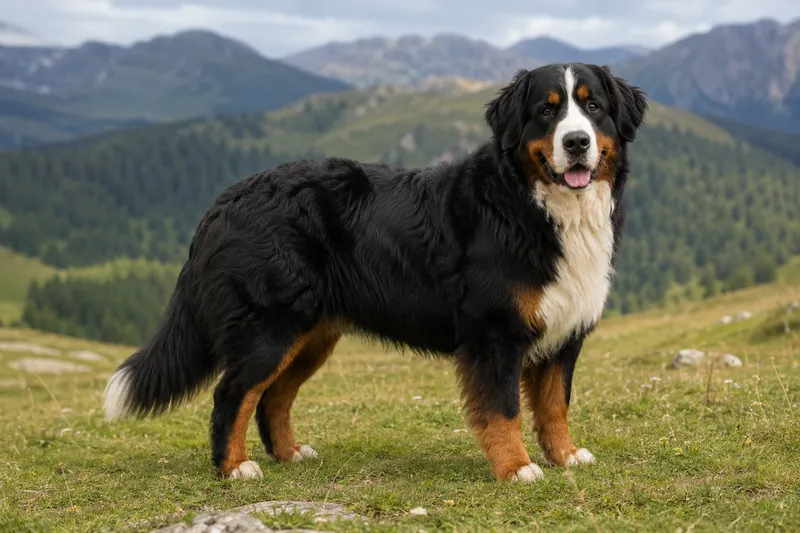
Bernese Mountain Dog
The Bernese Mountain Dog, or Berner Sennenhund, developed in the Swiss canton of Bern as a versatile farm dog. Its traditional work included moving cattle, guarding farmsteads, and pulling carts. It is one of four…
Recognized by: AKC · ANKC · +5
Size
Large
Weight
31.8–52.2 kg
Life span
7–10 years
Breed Traits
Energy Level
Moderate energy
Energy Level: 3 of 5
Low energyHigh energyChild / Family Compatibility
High compatibility
Child / Family Compatibility: 4 of 5
Low compatibilityHigh compatibilityGrooming Need
High grooming need
Grooming Need: 4 of 5
Low maintenanceHigh maintenanceTrainability
Easy to train
Trainability: 4 of 5
Hard to trainEasy to trainApartment / Home Suitability
Struggles in small spaces
Apartment / Home Suitability: 2 of 5
Needs space / yardExcellent for apartmentsAlone-Time Tolerance
Half-day is hard
Alone-Time Tolerance: 2 of 5
Needs frequent companyHandles long alone timeFirst-Time Owner Suitability
Manageable with guidance
First-Time Owner Suitability: 3 of 5
Needs experienced ownerGreat for first-time ownersCompatibility with Other Pets
Generally gets along well with other pets
Compatibility with Other Pets: 4 of 5
Single-pet homes are a better fitHighly compatible with other animals
The Bernese Mountain Dog, or Berner Sennenhund, developed in the Swiss canton of Bern as a versatile farm dog. Its traditional work included moving cattle, guarding farmsteads, and pulling carts.
It is one of four Swiss mountain and cattle dog breeds and the only one with a long coat. A typical Berner is large, sturdy, and balanced, with a black base coat, rich rust markings, and clearly defined white markings.
Natural ears are medium-sized and hang close to the head, while the long, bushy tail is carried low when relaxed. Although now widely kept as a companion, the breed retains the strength, willingness, and close human partnership of its working heritage.
Bernese Mountain Dogs are commonly affectionate, steady, and strongly attached to their families. Many are gentle and patient, but their size means that calm manners should be taught from puppyhood rather than assumed.
They may be reserved with unfamiliar people without being fearful or aggressive. Early, positive exposure to different people, animals, surfaces, sounds, and environments helps a young Berner develop into a confident adult.
The breed is intelligent and generally eager to cooperate, yet it can be sensitive to harsh handling. Short, reward-based training sessions with clear boundaries usually suit it better than forceful corrections or repetitive drilling.
A Bernese Mountain Dog needs daily activity, but most adults do well with moderate walks, outdoor exploration, training, and suitable working or pulling activities. Growing puppies should avoid forced running, repeated high-impact jumping, and excessive loads while their joints are developing.
The thick double coat sheds throughout the year and more heavily during seasonal changes. Brush at least weekly and more often during heavy shedding, while also maintaining the nails, teeth, and hanging ears.
This cold-weather breed can overheat in warm conditions, so exercise should be shifted to cooler hours with shade and water available. A Berner needs room to move safely and regular family contact; prolonged isolation or life confined to a yard does not meet its social needs.
Bernese Mountain Dogs have a comparatively short average lifespan and an important breed-associated burden of cancer, including histiocytic sarcoma. Other concerns can include hip and elbow dysplasia, degenerative myelopathy, eye and cardiac conditions, von Willebrand disease, and gastric dilatation-volvulus (GDV or bloat).
The Bernese Mountain Dog Club of America recommends hip, elbow, eye, cardiac, and degenerative myelopathy screening for breeding dogs, plus an additional test selected from von Willebrand disease, thyroid evaluation, or a histiocytic sarcoma risk test. A CHIC number confirms that required results were completed and made public, but it does not mean every result was normal or guarantee a puppy's future health.
Owners should maintain a lean body condition, discuss age-appropriate joint and cancer awareness with their veterinarian, and seek urgent veterinary care for sudden abdominal swelling, unproductive retching, collapse, or severe restlessness because these can accompany GDV. Prospective owners should ask breeders for verifiable health results and relevant health history across close relatives, not rely only on verbal assurances.
This information is for general educational purposes and is not a substitute for diagnosis or treatment by a veterinarian.
Recognizing organizations
Independent registries that list this breed. Tap a badge to learn more.
These statuses reflect each registry’s recording and show systems. They are not a health, quality, or superiority score.
AKCFull recognitionhttps://www.akc.org/dog-breeds/bernese-mountain-dog/ ANKCFull recognitionhttps://dogsaustralia.org.au/members/breeds/breed-standards/Bernese-Mountain-Dog CKCRecognized breedhttps://www.ckc.ca/en/Choosing-a-Dog/Choosing-a-Breed/Working-Dogs/Bernese-Mountain-Dog FCIDefinitive recognitionhttps://www.fci.be/EN/nomenclature/BERNESE-MOUNTAIN-DOG-45.html NZKCRecognised breedhttps://www.dogsnz.org.nz/breeds/info/bernese-mountain-dog/615 RKCBreed Registerhttps://www.royalkennelclub.com/search/breeds-a-to-z/breeds/working/bernese-mountain-dog/ UKCFull recognitionhttps://www.ukcdogs.com/bernese-mountain-dog
Frequently asked questions
Is a Bernese Mountain Dog a good family dog?
A well-socialized Bernese Mountain Dog is often affectionate, patient, and closely bonded with its household. Its large body can accidentally knock over a small child, so interactions should be supervised and both dog and child should be taught respectful boundaries. Individual temperament and upbringing still matter.
Can a Bernese Mountain Dog live in an apartment?
Apartment living is possible only when the dog has enough indoor space, reliable daily outdoor activity, and easy access that does not require excessive stair use. The breed's size, heavy shedding, heat sensitivity, and need for companionship make a roomy, cool home more practical. A yard is useful but does not replace walks or family interaction.
How much exercise does a Bernese Mountain Dog need?
Most healthy adults benefit from moderate daily exercise such as walks, hiking in cool weather, training, and appropriate working activities. They are capable dogs but are not designed for relentless high-speed exercise, especially in heat. Puppies need controlled activity that protects developing bones and joints.
Do Bernese Mountain Dogs shed a lot?
Yes, the long double coat sheds year-round and usually sheds more heavily during seasonal coat changes. Weekly brushing is a practical minimum, with more frequent grooming during heavy shedding. Routine grooming also provides a chance to check the skin, ears, nails, and any new lumps or changes.
Are Bernese Mountain Dogs easy to train?
They are generally intelligent and willing to work with people, which can make training rewarding. Because many are sensitive, calm reward-based methods are more suitable than intimidation or harsh correction. Early leash skills and polite greetings are especially important before the dog reaches full size.
Can Bernese Mountain Dogs live with other pets?
Many Bernese Mountain Dogs can live peacefully with other dogs and cats when socialized and introduced carefully. Compatibility depends on the individuals, their histories, and how resources and space are managed. Early success should still be supported with supervision rather than assuming every Berner will welcome every animal.
How well do Bernese Mountain Dogs tolerate hot weather?
Their dense double coat makes sustained heat difficult, and they are generally better suited to cool conditions. During warm weather, provide shade, fresh water, indoor cooling, and exercise in the cooler parts of the day. Heavy panting, weakness, confusion, or collapse requires immediate action and veterinary attention.
What health checks should a Bernese Mountain Dog breeder provide?
Ask for independently verifiable results for hips, elbows, eyes, heart, and degenerative myelopathy, along with the additional testing recommended by the breed's parent club. Review the actual results and health history of parents and close relatives rather than accepting a claim that a line is simply healthy. Screening improves informed breeding decisions but cannot guarantee that a puppy will never develop disease.
More about Bernese Mountain Dog
Pet profiles are coming soon. For now, keep exploring trusted breed knowledge in the Breed Guide.
Back to Breed Guide