

Bengal
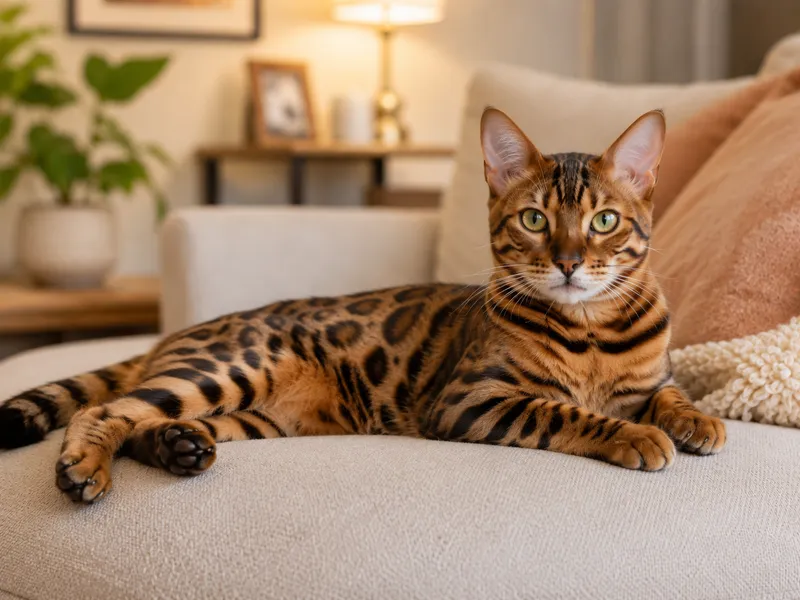
The Bengal is a medium-sized to moderately large, muscular cat with a long substantial body, powerful hindquarters, rounded paws, and an alert, athletic presence. Its short, dense coat may display sharply defined spots,…
Recognized by: CFA · FIFe · +2
Size
Medium
Weight
2.7–6.8 kg
Life span
12–20 years
Breed Traits
Energy Level
Very energetic
Energy Level: 5 of 5
Low energyHigh energyChild / Family Compatibility
High compatibility
Child / Family Compatibility: 4 of 5
Low compatibilityHigh compatibilityGrooming Need
Low grooming need
Grooming Need: 1 of 5
Low maintenanceHigh maintenanceTrainability
Very easy to train
Trainability: 5 of 5
Hard to trainEasy to trainApartment / Home Suitability
Moderate — depends on setup
Apartment / Home Suitability: 3 of 5
Needs space / yardExcellent for apartmentsAlone-Time Tolerance
Half-day is hard
Alone-Time Tolerance: 2 of 5
Needs frequent companyHandles long alone timeFirst-Time Owner Suitability
Challenging for beginners
First-Time Owner Suitability: 2 of 5
Needs experienced ownerGreat for first-time ownersCompatibility with Other Pets
Can adapt with proper socialization
Compatibility with Other Pets: 3 of 5
Single-pet homes are a better fitHighly compatible with other animals
The Bengal is a medium-sized to moderately large, muscular cat with a long substantial body, powerful hindquarters, rounded paws, and an alert, athletic presence. Its short, dense coat may display sharply defined spots, two-tone rosettes, or flowing marbled patterns, while some individuals show a reflective sheen often called glitter.
The breed was developed through planned crosses between domestic cats and the Asian leopard cat, followed by generations of selection for domestic temperament and consistent breed type. Modern pedigree Bengals are bred Bengal to Bengal, while early-generation foundation cats remain subject to separate registration and showing rules.
Bengals commonly reach full physical size at around two years of age. Their striking appearance attracts attention, but their defining household qualities are high intelligence, persistent curiosity, athletic ability, and a strong need for interaction and environmental enrichment.
Bengals are typically energetic, confident, inquisitive, and closely engaged with their household. Many follow people between rooms, investigate cupboards and running water, climb to high observation points, and seek active participation rather than spending most of the day resting.
They often enjoy retrieving toys, learning routines, using puzzle feeders, exploring secure climbing systems, and participating in short reward-based training sessions. Vocal behavior varies: some Bengals communicate frequently and forcefully, while others are comparatively quiet.
Well-socialized Bengals can live successfully with respectful children, compatible cats, and cat-friendly dogs. Their speed and intensity may overwhelm timid animals or very quiet households, so gradual introductions, supervised play, and individual retreat spaces are important.
The Bengal's short coat is relatively easy to maintain and usually needs only weekly gentle brushing to remove loose hair. Routine coat care should be combined with nail trimming, dental hygiene, ear checks, and regular observation for skin or coat changes.
Daily physical and mental activity is essential. Tall, stable climbing furniture, strong scratching posts, food puzzles, rotating toys, and several interactive play sessions can help channel normal chasing, jumping, and problem-solving behavior into appropriate outlets.
Bengals can live indoors and in apartments when their environment is secure and highly enriched, but a small or unstimulating home may be difficult for an active individual. Food portions should reflect age, body condition, health, and activity rather than assuming that every energetic cat can eat without limits.
Bengal progressive retinal atrophy, known as PRA-b, is an inherited condition that can gradually cause severe vision loss. A DNA test is available to identify cats with zero, one, or two copies of the associated recessive variant, allowing breeders to make informed pairing decisions.
Pyruvate kinase deficiency is another inherited disorder for which DNA testing is available in Bengals and may cause intermittent hemolytic anemia in affected cats. Hypertrophic cardiomyopathy also occurs in some Bengal lines; there is no validated Bengal-specific DNA test that excludes HCM, so veterinary cardiac screening and family history remain important.
Prospective owners should request documented PRA-b and pyruvate kinase deficiency results and ask how breeding cats are evaluated for heart health. This information is for general educational purposes and is not a substitute for diagnosis or treatment by a veterinarian.
Recognizing organizations
Independent registries that list this breed. Tap a badge to learn more.
These statuses reflect each registry’s recording and show systems. They are not a health, quality, or superiority score.
CFAChampionshiphttps://cfa.org/breed/bengal/ FIFeFully recognisedhttps://fifeweb.org/cats/breeds/ FIFePreliminary recognisedCharcoal — Preliminary recognisedhttps://fifeweb.org/2025/05/23/preliminary-recognition-of-the-charcoal-variety-in-bengal/ GCCFChampionship statusBrown (Black), Snow, Black Silver and Silver Snow varieties — Championship statushttps://www.gccfcats.org/wp-content/uploads/2026/03/Bengal-Registration-Policy-02.2026.pdf GCCFPreliminary statusBlue, Blue Snow, Blue Silver and Blue Silver Snow varieties — Preliminary statushttps://www.gccfcats.org/wp-content/uploads/2026/03/Bengal-Registration-Policy-02.2026.pdf TICAChampionshiphttps://tica.org/breed/bengal/
Frequently asked questions
Are Bengal cats good family pets?
Bengals can be affectionate and entertaining family companions when their exercise, training, and social needs are met. Children should be taught to handle the cat gently and to avoid using hands as toys during energetic play.
Can a Bengal cat live in an apartment?
A Bengal can live in an apartment if it has stable vertical territory, scratching areas, puzzle activities, and several daily play sessions. Apartment suitability depends more on enrichment and owner involvement than on floor area alone.
Can Bengal cats be left alone during the day?
Most adult Bengals can manage ordinary short absences, but frequent prolonged isolation may lead to boredom or unwanted behavior. A predictable routine, challenging enrichment, and meaningful interaction before and after absences are important.
How much exercise does a Bengal cat need?
Bengals have very high activity needs and usually benefit from several active play sessions each day. Climbing, chasing, retrieving, puzzle feeding, and voluntary training help exercise both the body and the mind.
Do all Bengal cats like water?
Many Bengals show interest in dripping taps, sinks, or moving water, but this is not universal. Water access should be supervised, and toilets, deep containers, and unsafe household water sources should remain secured.
How much grooming does a Bengal need?
The short coat is low maintenance and usually needs only light weekly brushing. Dental care, nail trimming, ear checks, and routine veterinary care remain necessary even though coat grooming is simple.
Are Bengal cats hypoallergenic?
No cat breed is guaranteed to be hypoallergenic, and Bengals still produce common feline allergens. People with allergies should spend time around individual Bengals and seek medical guidance before making a long-term commitment.
What health screening should a Bengal breeder discuss?
A responsible breeder should provide documented DNA results for PRA-b and pyruvate kinase deficiency and explain the cardiac screening used for breeding cats. Buyers should also ask about family health history and whether echocardiographic evaluations are repeated over time.
More about Bengal
Pet profiles are coming soon. For now, keep exploring trusted breed knowledge in the Breed Guide.
Back to Breed Guide