

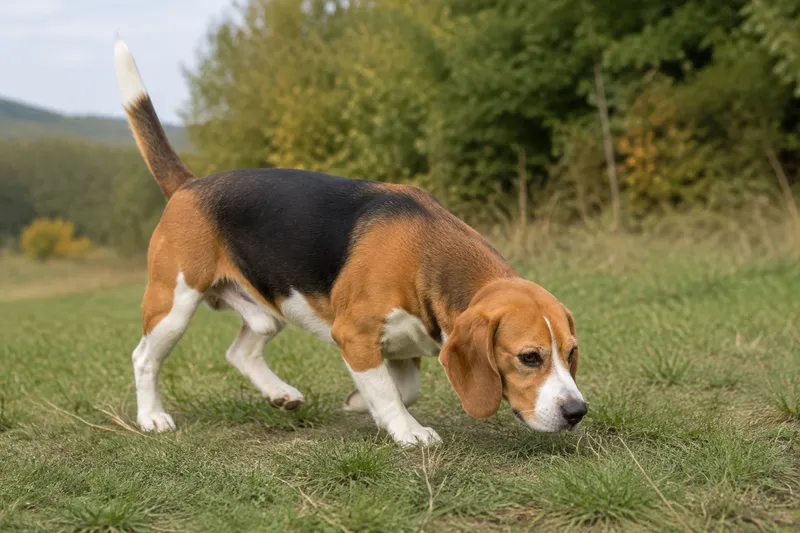
Beagle
The Beagle is a sturdy, compact scent hound developed to pursue hare and rabbit by following ground scent while hunters kept pace on foot. Its broad nose, long low-set ears, strong body, weather-resistant coat, and…
Recognized by: AKC · ANKC · +5
Size
Small
Weight
6.8–13.6 kg
Life span
10–15 years
Breed Traits
Energy Level
High energy
Energy Level: 4 of 5
Low energyHigh energyChild / Family Compatibility
Very high compatibility
Child / Family Compatibility: 5 of 5
Low compatibilityHigh compatibilityGrooming Need
Light grooming need
Grooming Need: 2 of 5
Low maintenanceHigh maintenanceTrainability
Moderately trainable
Trainability: 3 of 5
Hard to trainEasy to trainApartment / Home Suitability
Moderate — depends on setup
Apartment / Home Suitability: 3 of 5
Needs space / yardExcellent for apartmentsAlone-Time Tolerance
Half-day is hard
Alone-Time Tolerance: 2 of 5
Needs frequent companyHandles long alone timeFirst-Time Owner Suitability
Manageable with guidance
First-Time Owner Suitability: 3 of 5
Needs experienced ownerGreat for first-time ownersCompatibility with Other Pets
Can adapt with proper socialization
Compatibility with Other Pets: 3 of 5
Single-pet homes are a better fitHighly compatible with other animals
The Beagle is a sturdy, compact scent hound developed to pursue hare and rabbit by following ground scent while hunters kept pace on foot. Its broad nose, long low-set ears, strong body, weather-resistant coat, and typically white-tipped tail support a working style that combines scenting precision, endurance, and visibility in cover.
Modern breed standards do not define the Beagle identically in every country. AKC and CKC competition divides the breed into a class at or below 13 inches and another over 13 but no more than 15 inches, while British-derived and FCI standards generally describe one breed with a desirable height of approximately 33 to 40 centimetres.
Beagles remain capable hunting and field-trial hounds, but their manageable size and cheerful social nature have also made them familiar companions. Prospective owners should look beyond the appealing expression and understand that the breed retains a powerful nose, an audible hound voice, substantial stamina, and a strong instinct to investigate scent trails independently.
Beagles are typically merry, curious, affectionate, and comfortable in company because generations of pack work favored cooperation with other hounds. Many form warm relationships with adults and children and enjoy compatible dogs, although enthusiasm around food, play, and greetings still requires household manners and supervision.
Training calls for patience, consistency, and rewards valuable enough to compete with environmental scents. A Beagle may understand a cue perfectly yet choose to follow an odor, so early work should emphasize attention, recall foundations, loose-leash walking, settling, handling, and calm behavior around food without relying on punishment or expecting automatic obedience.
Barking, baying, and howling are normal parts of the breed's communication and hunting heritage. Socialization should include people, animals, traffic, veterinary care, household sounds, and controlled time alone, while unwanted vocalizing is best reduced through adequate activity, predictable routines, reinforced quiet behavior, and management of triggers rather than attempts to remove the hound temperament entirely.
A healthy adult Beagle needs meaningful daily exercise together with opportunities to use its nose and brain. Brisk walks, structured sniffing, tracking games, scent work, food searches, and play in a securely fenced area are useful, but routine off-leash freedom in unenclosed places is risky because an interesting trail can rapidly override recall.
The short, dense coat is relatively simple to maintain but sheds throughout the year and may shed more heavily during seasonal changes. Weekly brushing, occasional bathing, nail trimming, and dental care are generally practical, while the hanging ears should be checked and kept dry because reduced air circulation can allow irritation or infection to develop.
Beagles are often highly food-motivated and can gain excess weight when portions, treats, scavenging, and activity are not managed carefully. They also tend to cope poorly with frequent prolonged isolation, so gradual alone-time training, safe enrichment, secure storage of food and waste, and dependable human or suitable canine companionship are important parts of everyday management.
Hip dysplasia, inherited eye disorders, cardiac disease, autoimmune thyroiditis, and Musladin-Lueke syndrome are central screening priorities identified by the American parent club. Beagles may also be affected by epilepsy, allergies, back problems, patellar luxation, and other conditions whose relevance varies among families and regional populations.
Additional DNA-screenable concerns used in some breeding programs include Lafora disease, neonatal cerebellar cortical degeneration, Factor VII deficiency, and Imerslund-Grasbeck syndrome. Routine owners should also watch for obesity, ear inflammation, dental disease, persistent lameness, seizures, vision changes, unexplained weakness, or altered exercise tolerance and seek veterinary assessment rather than attempting to diagnose these signs from breed information alone.
A responsible breeder should provide verifiable hip, cardiac, ophthalmologist, thyroid, and MLS results for the parents under the applicable program. Buyers should also ask which additional DNA tests are relevant to the breeder's country and bloodlines, review results rather than accepting verbal assurances, and discuss health and longevity among close relatives because no screening program can guarantee an unaffected dog. This information is for general educational purposes and is not a substitute for diagnosis or treatment by a veterinarian.
Recognizing organizations
Independent registries that list this breed. Tap a badge to learn more.
These statuses reflect each registry’s recording and show systems. They are not a health, quality, or superiority score.
AKCFull recognitionhttps://www.akc.org/dog-breeds/beagle/ ANKCFull recognitionhttps://www.dogsaustralia.org.au/members/breeds/breed-standards/Beagle CKCRecognized breedhttps://www.ckc.ca/en/Choosing-a-Dog/Choosing-a-Breed/Hounds/Beagle FCIDefinitive recognitionhttps://www.fci.be/en/nomenclature/BEAGLE-161.html NZKCRecognised breedhttps://www.dogsnz.org.nz/breeds/info/beagle/416 RKCBreed Registerhttps://www.royalkennelclub.com/search/breeds-a-to-z/breeds/hound/beagle/ UKCFull recognitionhttps://www.ukcdogs.com/beagle
Frequently asked questions
Are 13-inch and 15-inch Beagles separate breeds?
They are size classes within the same Beagle breed under AKC and CKC competition rules, not separate breeds. Other registries may use a single desirable height range, so the classification applied to an individual dog depends on the governing standard.
Are Beagles good family dogs?
A well-socialized Beagle is often affectionate, playful, and comfortable with children because the breed was developed to work cooperatively in packs. Adults should still supervise young children, teach respectful interaction, and manage the dog's enthusiasm around food, doors, and active play.
How much exercise does a Beagle need?
Most healthy adults need meaningful daily exercise rather than only brief toilet walks. Brisk walking, controlled sniffing, tracking games, scent work, and secure play can be combined according to the dog's age, health, conditioning, and individual drive.
Can a Beagle live in an apartment?
Apartment life can work when the dog receives sufficient outdoor activity, scent-based enrichment, toilet access, training, and companionship. Barking, baying, and howling may create difficulties with neighbors, so prospective owners must plan realistically for sound management and alone-time training.
Can Beagles safely walk off leash?
Their powerful scent drive can cause even a trained Beagle to follow a trail beyond the owner's reach, traffic awareness, or property boundary. A secure fenced area or a suitable long line is generally safer than routine off-leash freedom in unenclosed places.
Can Beagles be left alone during the day?
Beagles can learn to remain settled for reasonable periods, but frequent long isolation conflicts with their strongly social nature and may contribute to vocalizing or destructive behavior. Independence should be developed gradually, with exercise, enrichment, toilet breaks, and reliable companionship arranged around absences.
Do Beagles shed and need much grooming?
The short weather-resistant coat sheds throughout the year and may release more hair seasonally, but its routine maintenance is straightforward. Weekly brushing, periodic bathing, nail and dental care, and regular checks of the hanging ears are usually more important than elaborate coat trimming.
What health screening should a Beagle breeder provide?
The American parent-club program recommends hip, cardiac, ophthalmologist, thyroid, and Musladin-Lueke syndrome evaluations for breeding dogs. Buyers should verify the results and ask whether Lafora disease, NCCD, Factor VII deficiency, IGS, patella, or other testing is appropriate for the breeder's region and bloodlines.
More about Beagle
Pet profiles are coming soon. For now, keep exploring trusted breed knowledge in the Breed Guide.
Back to Breed Guide