

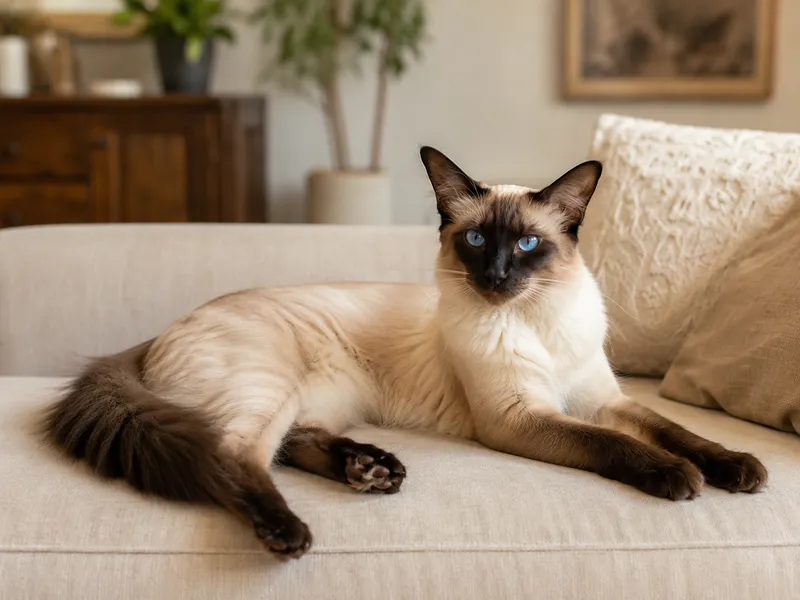
Balinese
The Balinese is a medium-sized, long and finely built cat with firm musculature, slender legs, a tubular body, a wedge-shaped head, very large ears, and deep blue almond-shaped eyes. Its fine semi-long coat lies close…
Recognized by: CFA · FIFe · +2
Size
Medium
Weight
2.3–5.4 kg
Life span
15–20 years
Breed Traits
Energy Level
Very energetic
Energy Level: 5 of 5
Low energyHigh energyChild / Family Compatibility
Very high compatibility
Child / Family Compatibility: 5 of 5
Low compatibilityHigh compatibilityGrooming Need
Light grooming need
Grooming Need: 2 of 5
Low maintenanceHigh maintenanceTrainability
Very easy to train
Trainability: 5 of 5
Hard to trainEasy to trainApartment / Home Suitability
Fits apartments well
Apartment / Home Suitability: 4 of 5
Needs space / yardExcellent for apartmentsAlone-Time Tolerance
Very short alone time (a few hours)
Alone-Time Tolerance: 1 of 5
Needs frequent companyHandles long alone timeFirst-Time Owner Suitability
Manageable with guidance
First-Time Owner Suitability: 3 of 5
Needs experienced ownerGreat for first-time ownersCompatibility with Other Pets
Shows very high compatibility
Compatibility with Other Pets: 5 of 5
Single-pet homes are a better fitHighly compatible with other animals
The Balinese is a medium-sized, long and finely built cat with firm musculature, slender legs, a tubular body, a wedge-shaped head, very large ears, and deep blue almond-shaped eyes. Its fine semi-long coat lies close to the body without a dense woolly undercoat and becomes most noticeable on the plume-like tail.
The breed is essentially the longhaired counterpart of the modern Siamese. Both share the same colorpoint pattern, in which the face, ears, legs, feet, and tail are darker than the warmer central areas of the body. Accepted point colors and patterns vary between registries and may include traditional, red, cream, tortie, tabby or lynx, silver, and white-marked combinations.
Longhaired kittens occasionally appeared in Siamese litters before organised breeding began. During the 1950s, breeders including Marion Dorsey and Helen Smith began intentionally developing the longhaired form. Smith selected the name Balinese because the cats' graceful movement reminded her of Balinese dancers; the breed was developed in the United States and does not originate from Bali.
Balinese cats are generally affectionate, intelligent, athletic, vocal, and intensely interested in their household. Many follow familiar people between rooms, seek lap or bed contact, respond when spoken to, and expect to participate in daily activities rather than remain independent observers.
They retain a playful, kitten-like attitude throughout much of adulthood and commonly enjoy retrieving toys, climbing, puzzle feeders, clicker training, harness walking, and energetic interactive games. Without sufficient social contact and stimulation, their intelligence can be redirected toward opening cupboards, exploring restricted areas, or demanding attention vocally.
Well-socialized Balinese cats commonly live successfully with respectful children, compatible cats, and cat-friendly dogs. Their strong social needs make them poorly suited to frequent prolonged isolation, and many individuals benefit from living with another active and compatible companion.
The fine single coat is easier to maintain than the coats of many densely undercoated longhair breeds. A gentle weekly comb-through is normally sufficient to remove loose hair and prevent small tangles, with additional attention to the plume-like tail and areas behind the ears.
Daily life should include energetic interactive play, tall and stable climbing furniture, scratching surfaces, puzzle activities, and frequent social engagement. Balinese cats can adapt well to apartment living, but prospective owners should be prepared for an active, vocal cat that requires companionship and meaningful indoor enrichment.
Routine care should include dental hygiene, nail trimming, ear checks, body-condition monitoring, and regular veterinary examinations. Their long, fine frame should remain muscular rather than bony, so feeding should be adjusted according to age, activity, and individual body condition.
Progressive retinal atrophy rdAc is an autosomal recessive inherited eye disorder associated with a CEP290 variant found in the Siamese-related breed group, including Balinese cats. Affected cats begin life with normal vision, but retinal degeneration may develop during youth and gradually progress to severe vision loss or blindness. A DNA test can identify genetically clear, carrier, and affected cats.
Occasional crossed eyes and congenital tail kinks have historically occurred in Siamese-related populations and may also appear in Balinese lines. Their presence and significance vary between individual cats, and a visible tail kink or marked eye abnormality may also affect eligibility under some show standards.
Published registry guidance is not fully consistent regarding amyloidosis: some sources mention possible susceptibility through Siamese ancestry, while others state that it has not been established as a Balinese problem. No routine DNA test can exclude every form of amyloidosis. Prospective owners should request documented PRA rdAc results and ask about family eye, liver, kidney, respiratory, and general health, longevity, known illnesses, and causes of death. This information is for general educational purposes and is not a substitute for diagnosis or treatment by a veterinarian.
Recognizing organizations
Independent registries that list this breed. Tap a badge to learn more.
These statuses reflect each registry’s recording and show systems. They are not a health, quality, or superiority score.
Frequently asked questions
Are Balinese cats good family pets?
Balinese cats are often affectionate, playful, and highly involved family companions. They commonly live well with respectful children who understand gentle handling and enjoy participating in energetic interactive play.
Do Balinese cats get along with other pets?
Well-socialized Balinese cats generally have a high potential to live successfully with compatible cats and cat-friendly dogs. Many individuals appreciate having an active companion, although all introductions should still be gradual.
Can a Balinese live in an apartment?
A Balinese can live successfully in an apartment when provided with climbing space, energetic daily play, scratching areas, puzzle activities, and frequent companionship. Prospective owners should also be comfortable living with an active and vocal cat.
Can Balinese cats be left alone during the day?
Most adults can manage ordinary short absences, but the breed is poorly suited to frequent prolonged isolation. A predictable routine, extensive enrichment, and a compatible human or animal companion can help meet its strong social needs.
How much grooming does a Balinese need?
The silky semi-long coat normally needs gentle combing about once a week. Because it lacks a heavy woolly undercoat, it is generally less prone to matting than many fuller-coated longhair breeds.
What is the difference between a Balinese and a Siamese?
The two share essentially the same elegant body type, colorpoint pattern, blue eyes, intelligence, and social temperament. The principal difference is coat length: the Balinese has a fine semi-long coat and plume-like tail, while the Siamese has a very short close-lying coat.
What is the difference between a Balinese and an Oriental Longhair?
Both share a similar long, athletic body and silky semi-long coat. The Balinese is colorpointed and has blue eyes, while the Oriental Longhair is generally shown in non-pointed colors and patterns with eye-color rules that vary according to coat color and registry.
Is the Javanese a separate breed from the Balinese?
The answer depends on the registry. CFA merged the former Javanese into the Balinese breed in 2008 and now uses separate Balinese and Javanese color divisions. Other organisations may use different names or classify the same colors within Balinese without maintaining a separate Javanese breed.
What health testing should a Balinese breeder discuss?
A responsible breeder should provide documented PRA rdAc DNA results and discuss family eye, liver, kidney, respiratory, and general health. Buyers should also ask about longevity, known illnesses, veterinary screening practices, and causes of death in related cats.
More about Balinese
Pet profiles are coming soon. For now, keep exploring trusted breed knowledge in the Breed Guide.
Back to Breed Guide