

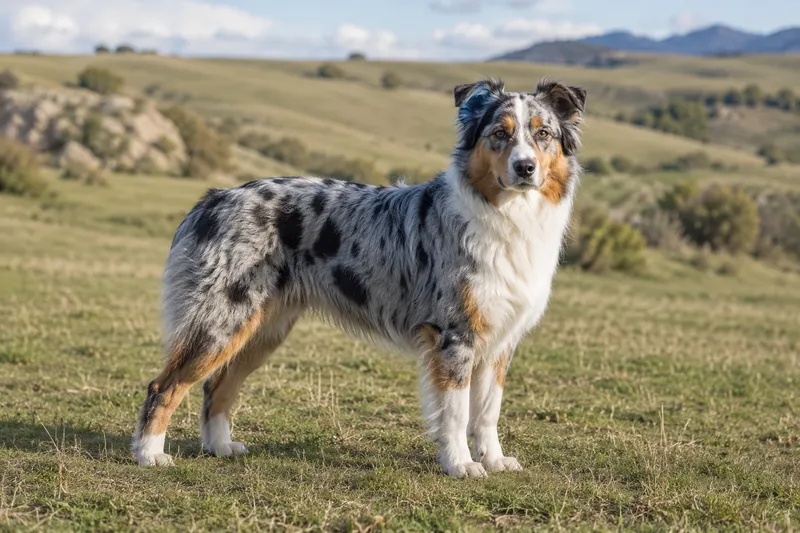
Australian Shepherd
The Australian Shepherd is a medium-sized, agile herding dog with a balanced, slightly rectangular build and a weather-resistant double coat. Black, red, blue merle, and red merle are established colors, with or without…
Recognized by: AKC · ANKC · +5
Size
Medium
Weight
18.1–29.5 kg
Life span
12–15 years
Breed Traits
Energy Level
Very energetic
Energy Level: 5 of 5
Low energyHigh energyChild / Family Compatibility
High compatibility
Child / Family Compatibility: 4 of 5
Low compatibilityHigh compatibilityGrooming Need
Moderate grooming need
Grooming Need: 3 of 5
Low maintenanceHigh maintenanceTrainability
Very easy to train
Trainability: 5 of 5
Hard to trainEasy to trainApartment / Home Suitability
Struggles in small spaces
Apartment / Home Suitability: 2 of 5
Needs space / yardExcellent for apartmentsAlone-Time Tolerance
Half-day is hard
Alone-Time Tolerance: 2 of 5
Needs frequent companyHandles long alone timeFirst-Time Owner Suitability
Challenging for beginners
First-Time Owner Suitability: 2 of 5
Needs experienced ownerGreat for first-time ownersCompatibility with Other Pets
Generally gets along well with other pets
Compatibility with Other Pets: 4 of 5
Single-pet homes are a better fitHighly compatible with other animals
The Australian Shepherd is a medium-sized, agile herding dog with a balanced, slightly rectangular build and a weather-resistant double coat. Black, red, blue merle, and red merle are established colors, with or without white markings and copper points; natural bobtails occur, but full tails are also part of the breed.
Despite its name, the breed was developed primarily in the United States and became closely associated with ranch work in the American West. Dogs and shepherding traditions linked with Australia may have influenced the name, but the breed's exact ancestry and the routes taken by its early forebears remain debated.
Australian Shepherds continue to work livestock and are successful in agility, obedience, scent work, search activities, and many other dog sports. Their striking appearance can attract attention, but prospective owners should select for sound health and temperament and be ready for a highly active dog that needs purposeful engagement.
A typical Australian Shepherd is intelligent, energetic, attentive, and deeply engaged with its household. Many are reserved rather than immediately social with strangers, and their alertness or protective instincts require thoughtful socialization instead of encouragement to guard indiscriminately.
The breed learns quickly and often anticipates patterns before an owner realizes it. Reward-based training should combine useful skills with impulse control, relaxation, recall, and calm behavior around movement, because an under-stimulated Aussie may invent repetitive, noisy, or destructive activities.
Herding instinct varies, but some individuals stalk, circle, chase, or nip at heels when excited by children, bicycles, runners, or other animals. Owners should redirect these behaviors early, supervise busy situations, and provide appropriate outlets such as structured herding, agility, scent games, or controlled retrieving.
Most healthy adult Australian Shepherds need substantial exercise every day, often around two hours or more when walks, active play, training, and free movement are combined. Individual needs depend on age, health, and working line, and puppies should not be pushed through repetitive high-impact exercise while their joints are developing.
The medium-length double coat sheds throughout the year and more heavily during seasonal coat changes. Brushing several times a week, with more frequent work during heavy shedding, helps remove loose undercoat and prevent tangles; nails, teeth, ears, and skin also need routine attention.
Aussies thrive when they have both physical outlets and jobs that require thought, but they must also learn how to settle. They are usually poorly suited to long, routine periods alone, and success in a smaller home depends on reliable exercise, enrichment, noise control, and access to suitable outdoor spaces rather than indoor floor area alone.
Australian Shepherds can be affected by hip and elbow dysplasia and several inherited eye disorders, including collie eye anomaly, hereditary cataracts, and progressive retinal atrophy. Responsible breeding programs commonly use hip and elbow evaluations, regular examinations by a veterinary ophthalmologist, and relevant DNA tests rather than relying on appearance or a routine wellness check alone.
Some Australian Shepherds carry an MDR1 gene variant that can increase sensitivity to certain medications. A verified test result should be shared with the dog's veterinarian, who can interpret it when selecting or prescribing medication; owners should not change or withhold prescribed treatment on their own.
Merle coloring requires informed breeding decisions because mating two merle dogs raises the risk of puppies with serious hearing or vision impairment. Epilepsy and other health problems can also occur, so prospective owners should review documented results for both parents and understand that genetic testing reduces specific risks but cannot guarantee lifelong health.
This information is for general educational purposes and is not a substitute for diagnosis or treatment by a veterinarian.
Recognizing organizations
Independent registries that list this breed. Tap a badge to learn more.
These statuses reflect each registry’s recording and show systems. They are not a health, quality, or superiority score.
AKCFull recognitionhttps://www.akc.org/dog-breeds/australian-shepherd/ ANKCFull recognitionhttps://dogsaustralia.org.au/members/breeds/breed-standards/Australian-Shepherd CKCRecognized breedhttps://www.ckc.ca/en/Choosing-a-Dog/Choosing-a-Breed/Herding-Dogs/Australian-Shepherd FCIDefinitive recognitionhttps://www.fci.be/en/nomenclature/AUSTRALIAN-SHEPHERD-342.html NZKCRecognised breedhttps://www.dogsnz.org.nz/breeds/info/australian-shepherd/513 RKCBreed Registerhttps://www.royalkennelclub.com/search/breeds-a-to-z/breeds/pastoral/australian-shepherd/ UKCFull recognitionhttps://www.ukcdogs.com/australian-shepherd
Frequently asked questions
Is an Australian Shepherd a good family dog?
An Australian Shepherd can be a devoted family companion in an active household that enjoys training and outdoor activity. The breed is a poor match for families seeking a consistently low-energy dog that is content without structured engagement.
Is an Australian Shepherd suitable for a first-time owner?
A highly committed beginner can succeed with early access to a qualified reward-based trainer and a realistic daily routine. Many first-time owners underestimate how much exercise, mental work, coat care, and impulse-control training an Aussie requires.
How much exercise does an Australian Shepherd need?
Most healthy adults need substantial daily activity, often around two hours or more when walks, running, play, and training are combined. The quality of activity matters, so problem-solving, scent work, herding, or dog sports can be as important as physical distance.
Can an Australian Shepherd live in an apartment?
Apartment living is possible for an individual with reliable manners and an owner who consistently meets its needs outside the home. Daily exercise, mental enrichment, calm-settling practice, and management of alert barking are essential.
Are Australian Shepherds good with children?
Many Aussies form close, playful relationships with children when raised and socialized appropriately. Adults should supervise interactions and redirect chasing or heel-nipping because fast movement can trigger herding behavior.
Do Australian Shepherds get along with other pets?
They often live well with other dogs and cats when introductions are gradual and each animal has safe personal space. Individual prey drive and herding behavior vary, so smaller animals and high-energy play should be supervised.
How much grooming does an Australian Shepherd need?
The double coat usually needs brushing several times each week and more often during heavy seasonal shedding. Routine nail trimming, dental care, ear checks, and occasional bathing are also necessary, while shaving the coat is not normal maintenance.
What health tests should an Australian Shepherd breeder perform?
Ask for verifiable hip and elbow evaluations, current specialist eye examinations, and relevant DNA results such as CEA, HSF4 hereditary cataract, PRA, and MDR1. Breeders should also avoid merle-to-merle matings, and buyers should understand that clear test results reduce defined risks without guaranteeing that every puppy will remain disease-free.
More about Australian Shepherd
Pet profiles are coming soon. For now, keep exploring trusted breed knowledge in the Breed Guide.
Back to Breed Guide