

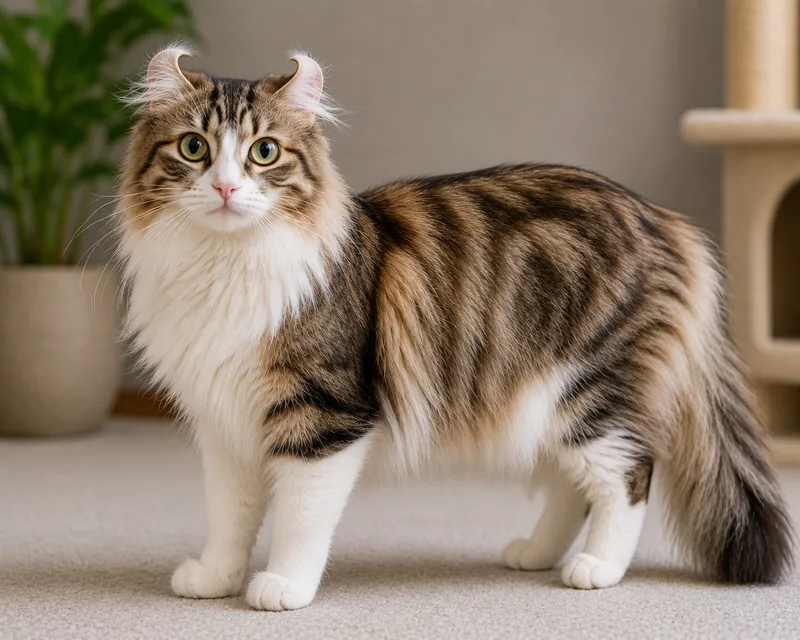
American Curl Longhair
The American Curl Longhair is the semi-longhaired form of the American Curl, a modern breed that began with a black longhaired stray named Shulamith in Lakewood, California, in 1981. Kittens with the same swept-back…
Recognized by: CFA · FIFe · +2
Size
Medium
Weight
2.3–4.5 kg
Life span
10–18 years
Breed Traits
Energy Level
High energy
Energy Level: 4 of 5
Low energyHigh energyChild / Family Compatibility
High compatibility
Child / Family Compatibility: 4 of 5
Low compatibilityHigh compatibilityGrooming Need
Moderate grooming need
Grooming Need: 3 of 5
Low maintenanceHigh maintenanceTrainability
Easy to train
Trainability: 4 of 5
Hard to trainEasy to trainApartment / Home Suitability
Fits apartments well
Apartment / Home Suitability: 4 of 5
Needs space / yardExcellent for apartmentsAlone-Time Tolerance
Half-day is hard
Alone-Time Tolerance: 2 of 5
Needs frequent companyHandles long alone timeFirst-Time Owner Suitability
Suitable for many first-timers
First-Time Owner Suitability: 4 of 5
Needs experienced ownerGreat for first-time ownersCompatibility with Other Pets
Generally gets along well with other pets
Compatibility with Other Pets: 4 of 5
Single-pet homes are a better fitHighly compatible with other animals
The American Curl Longhair is the semi-longhaired form of the American Curl, a modern breed that began with a black longhaired stray named Shulamith in Lakewood, California, in 1981. Kittens with the same swept-back ears appeared in her offspring, and organized breed development began in 1983 using carefully selected domestic longhaired and shorthaired cats.
This is a small-to-medium, balanced cat with a moderately muscled rectangular body, a gently contoured head, walnut-shaped eyes, and distinctive ears that curve backward in a smooth arc. Kittens are born with straight ears; the curl begins to develop during the first days of life and settles gradually over the following months. The ear tips should remain flexible and must not curl so tightly that they touch the head.
The Longhair has a fine, silky, semi-long coat that lies relatively flat because the undercoat is minimal. The tail is full and plumed, and a light ruff or longer furnishings may be visible without the dense, woolly appearance of heavily undercoated longhaired breeds. All genetically possible colours and patterns may occur.
American Curl Longhairs are generally affectionate, curious, playful, and strongly interested in household life. Many greet familiar people, follow activities from room to room, and request attention with gentle nudges, trills, or quiet cooing rather than persistent loud vocalization.
They often retain an energetic, kitten-like approach to play into adulthood. Interactive toys, retrieving games, puzzle feeders, climbing furniture, and short training sessions can provide useful mental and physical outlets for an intelligent cat that enjoys exploring doors, cupboards, and elevated spaces.
Well-socialized individuals commonly adapt to respectful children, compatible cats, and cat-friendly dogs. Breed tendencies do not replace individual temperament, and introductions should remain gradual. Regular companionship is important because repeated long periods without social contact or enrichment may lead to boredom.
The silky semi-long coat is usually less demanding than a dense double coat, but it still benefits from brushing or combing once or twice a week. Pay attention to the tail plume, belly, armpits, and areas behind the ears, increasing grooming during seasonal shedding or whenever tangles begin to form.
The curled ears require gentle handling. They should never be pulled, flattened, straightened, or forced farther backward because the cartilage can be damaged. Inspect the visible ear regularly without inserting objects into the canal, and seek veterinary assessment for pain, discharge, odor, swelling, persistent scratching, or sudden sensitivity.
Daily care should also include interactive exercise, secure climbing and scratching areas, dental hygiene, nail trimming, clean litter facilities, and measured portions of a complete life-stage-appropriate diet. American Curl Longhairs usually adapt well to apartment living when their need for movement, play, exploration, and companionship is consistently met.
Published breed-specific health data for the American Curl remain limited, and no single inherited disease is firmly established as a defining breed-wide disorder. The lack of a well-documented breed-wide condition does not guarantee that every individual or family line will be free from genetic or acquired disease.
The swept-back ear is inherited as an autosomal dominant trait. Current genetic references classify the American Curl ear phenotype as a non-disease appearance trait, but the precise causal variant has not yet been confirmed. It is distinct from the folded-ear phenotype associated with the TRPV4 variant in Scottish Fold cats, although recent population research detected that Scottish Fold-associated variant in some American Curl samples, making ancestry and line-specific testing relevant when Fold ancestry or skeletal concerns are possible.
Prospective owners should ask about family longevity, mobility, chronic pain, ear comfort, hearing, heart and kidney health, known illnesses, and causes of death among related cats. Breeding cats should receive veterinarian-guided screening based on examination findings, pedigree information, family history, and any relevant DNA results; a DNA result does not guarantee overall health. This information is for general educational purposes and is not a substitute for diagnosis or treatment by a veterinarian.
Recognizing organizations
Independent registries that list this breed. Tap a badge to learn more.
These statuses reflect each registry’s recording and show systems. They are not a health, quality, or superiority score.
Frequently asked questions
Are American Curl Longhairs good family cats?
American Curl Longhairs are generally affectionate, playful, and interested in family activity. Well-socialized individuals often live successfully with respectful children, but interactions should be supervised and the ears must never be pulled or forced backward.
Do American Curl Longhairs get along with other pets?
Many adapt well to compatible cats and calm, cat-friendly dogs after gradual introductions. Age, confidence, play style, and previous social experience remain important, so breed reputation should not replace careful observation.
Can an American Curl Longhair live in an apartment?
This variety can live comfortably in an apartment when provided with climbing furniture, scratching areas, puzzle activities, daily interactive play, and regular companionship. Windows and balconies should be secured for an inquisitive and athletic cat.
Can American Curl Longhairs be left alone during the day?
Many adults can manage ordinary short absences, but frequent prolonged isolation is not ideal for this people-oriented cat. A predictable routine and varied enrichment can help, although they do not replace dependable human interaction.
How much grooming does an American Curl Longhair need?
Brushing or combing once or twice a week is usually sufficient because the silky coat has little undercoat. The tail plume, belly, armpits, and areas behind the ears may need additional attention during shedding periods.
What is the difference between an American Curl Longhair and an American Curl Shorthair?
Both share the same body type, temperament tendencies, and swept-back ears. The Longhair has a semi-long silky coat and a full plumed tail, while the Shorthair has a shorter flat-lying coat and usually requires less grooming.
Is the American Curl Longhair a separate breed or a coat variety?
Classification depends on the registry. BondPals maintains a separate Atlas page, TICA and FIFe list the Longhair separately in their breed systems, while CFA recognises longhair and shorthair forms within the American Curl breed.
Do American Curl ears cause the same disease as Scottish Fold ears?
The two ear shapes have different established genetic backgrounds, and the American Curl trait is not currently classified as the Scottish Fold osteochondrodysplasia trait. Even so, painful ears, stiffness, lameness, an abnormal gait, or reduced mobility require veterinary assessment, and ancestry-aware testing may be appropriate in some lines.
More about American Curl Longhair
Pet profiles are coming soon. For now, keep exploring trusted breed knowledge in the Breed Guide.
Back to Breed Guide