Recognizing organizations
Independent registries that list this breed. Tap a badge to learn more.
These statuses reflect each registry’s recording and show systems. They are not a health, quality, or superiority score.
Breed Traits
High energy
Very high compatibility
Light grooming need
Very easy to train
Excellent apartment fit
Half-day is hard
Excellent for first-time owners
Shows very high compatibility
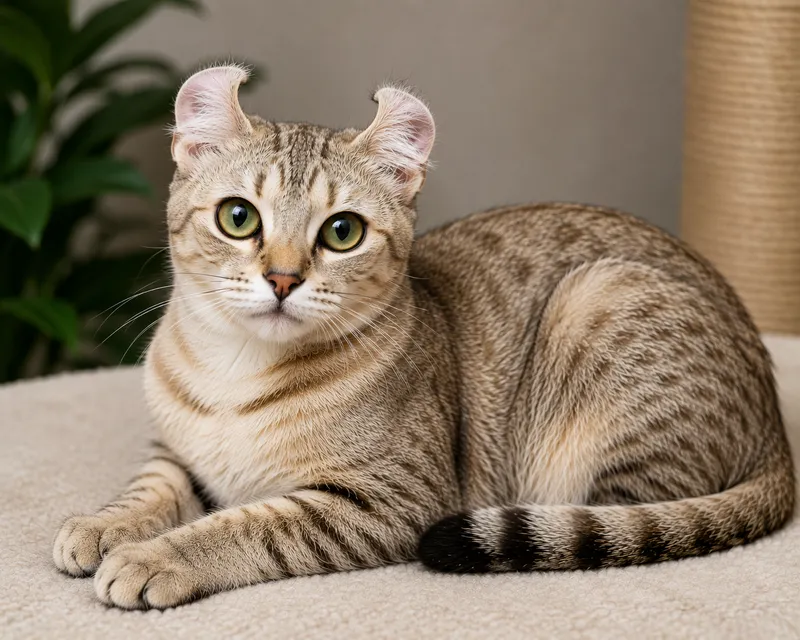
The American Curl is a small-to-medium, elegantly balanced cat with moderate musculature, a semi-foreign rectangular body, a softly modified wedge-shaped head, and large walnut-shaped eyes. Its defining feature is a pair of ears that curve smoothly backward in an arc rather than folding forward.
American Curl kittens are born with straight ears. The ears usually begin to curl within the first few days and continue changing until their final shape is established at about four months of age. The degree of curl varies, and extreme curvature in which the tip touches the ear or head is not desirable under major breed standards.
The breed began in Southern California in 1981 with a black longhaired stray named Shulamith. Her curled-ear offspring showed that the trait was inherited, and organised breeding began in 1983. American Curls occur in both shorthaired and longhaired varieties and may appear in any genetically possible colour or pattern.
Are American Curls good family cats?
American Curls are generally affectionate, playful, and adaptable family companions. Well-socialized individuals commonly live successfully with respectful children who understand gentle handling and do not pull or bend the cat's ears.
Do American Curls get along with other pets?
Well-socialized American Curls usually have a high potential to live successfully with compatible cats and cat-friendly dogs. Introductions should still be gradual because age, confidence, and previous experience affect every relationship.
Can an American Curl live in an apartment?
An American Curl can adapt very well to apartment living when provided with daily play, climbing and scratching areas, puzzle activities, observation points, and dependable companionship.
Can American Curls be left alone during the day?
Many adults can manage ordinary short absences, but frequent prolonged isolation is not ideal for this people-oriented breed. A predictable routine, enrichment, and regular interaction are important.
How much grooming does an American Curl need?
Shorthaired American Curls usually need light weekly brushing. Longhaired individuals may benefit from brushing once or twice a week, especially around the tail, but the limited undercoat generally makes both varieties easy to maintain.
Are American Curl Longhair and American Curl Shorthair separate breeds?
They are best understood as two coat varieties within the American Curl breed concept, although registries organise and code them differently. CFA treats them as one breed with two coat lengths, while TICA and FIFe use separate shorthaired and longhaired codes or listings within the same broader breed group.
What is the difference between an American Curl and a Scottish Fold?
The American Curl's ears curve backward, while the Scottish Fold's ears fold forward and downward. The Scottish Fold phenotype is associated with a TRPV4 cartilage disorder, whereas the usual American Curl ear trait is a different inherited characteristic and should not be described as Scottish Fold osteochondrodysplasia.
What health information should an American Curl breeder provide?
A responsible breeder should discuss family longevity, heart and kidney health, mobility, hearing, ear condition, known illnesses, causes of death, veterinary records, and any line-specific genetic or clinical screening. The breeder should also be able to explain the pedigree and confirm that Fold-related ancestry is not being used.
- Species
- Cat
More about American Curl
Pet profiles and public accounts open soon. For now, explore verified breed guides in the atlas.