

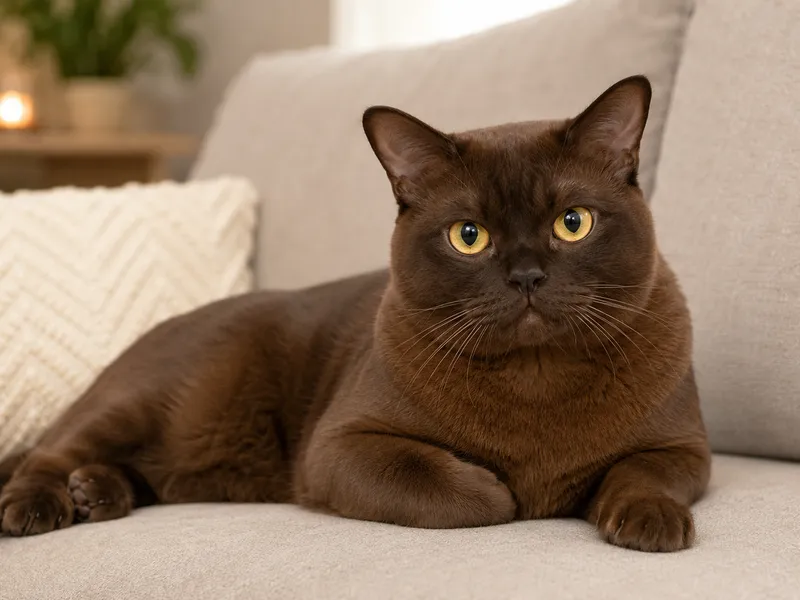
American Burmese
The American Burmese is a medium-sized, compact cat with substantial bone, powerful musculature, a rounded head, widely spaced expressive eyes, and a surprisingly heavy body for its apparent size. Its short, fine,…
Recognized by: CFA · TICA
Size
Medium
Weight
2.7–5.5 kg
Life span
12–16 years
Breed Traits
Energy Level
High energy
Energy Level: 4 of 5
Low energyHigh energyChild / Family Compatibility
Very high compatibility
Child / Family Compatibility: 5 of 5
Low compatibilityHigh compatibilityGrooming Need
Low grooming need
Grooming Need: 1 of 5
Low maintenanceHigh maintenanceTrainability
Very easy to train
Trainability: 5 of 5
Hard to trainEasy to trainApartment / Home Suitability
Excellent apartment fit
Apartment / Home Suitability: 5 of 5
Needs space / yardExcellent for apartmentsAlone-Time Tolerance
Very short alone time (a few hours)
Alone-Time Tolerance: 1 of 5
Needs frequent companyHandles long alone timeFirst-Time Owner Suitability
Suitable for many first-timers
First-Time Owner Suitability: 4 of 5
Needs experienced ownerGreat for first-time ownersCompatibility with Other Pets
Shows very high compatibility
Compatibility with Other Pets: 5 of 5
Single-pet homes are a better fitHighly compatible with other animals
The American Burmese is a medium-sized, compact cat with substantial bone, powerful musculature, a rounded head, widely spaced expressive eyes, and a surprisingly heavy body for its apparent size. Its short, fine, satin-like coat lies close to the body and is traditionally associated with sable, champagne, blue, and platinum coloring in the CFA standard.
This page uses the name American Burmese to distinguish the compact, round-headed type from the more moderately built European Burmese. Some international registries call this breed simply Burmese, so the additional geographic label is an editorial distinction intended to make the two BondPals Atlas entries clear.
The modern American breeding population traces primarily to Wong Mau, a brown cat brought to the United States in 1930. Planned matings helped establish the inherited sepia coloring and the compact physical type that later became the foundation of the American Burmese standard.
American Burmese cats are generally affectionate, confident, intelligent, and intensely interested in their household. Many follow familiar people between rooms, seek lap contact, greet visitors, and prefer participating in daily activities rather than observing from a distance.
They remain playful well into adulthood and commonly enjoy retrieving toys, puzzle feeders, climbing, interactive games, and short positive-reinforcement training sessions. Their curiosity and persistence can lead to unwanted exploration when the home provides too little stimulation.
Well-socialized American Burmese cats frequently live successfully with respectful children, compatible cats, and cat-friendly dogs. Their strong need for companionship makes them poorly suited to frequent prolonged isolation, especially in homes without another compatible companion.
The short, close-lying coat is very easy to maintain and usually needs only gentle weekly brushing or polishing with a soft grooming cloth. Frequent bathing and harsh brushing are unnecessary unless an individual cat has a specific coat or veterinary care need.
Daily life should include interactive play, stable climbing furniture, scratching surfaces, puzzle activities, and dependable social contact. American Burmese cats generally adapt very well to apartment living when their companionship, exercise, and mental-stimulation needs are consistently met.
Routine care should include dental hygiene, nail trimming, ear checks, body-condition monitoring, and regular veterinary examinations. Their compact, muscular build can make gradual fat gain difficult to recognize, so food portions and activity should be adjusted to the individual cat.
Burmese head defect, also called congenital frontonasal dysplasia, is particularly relevant to some contemporary American Burmese lines. Cats with two copies of the associated ALX1 variant develop severe craniofacial abnormalities that are incompatible with life, while cats with one copy may have a shortened facial structure and can transmit the variant. A DNA test is available for responsible breeding decisions.
Burmese hypokalaemic polymyopathy is an autosomal recessive condition that can cause episodes of skeletal muscle weakness, difficulty walking, or an inability to hold the head normally. A DNA test can identify clear, carrier, and genetically affected cats, making documented results important when the variant is present in a breeding population.
Hypertrophic cardiomyopathy has also been reported in Burmese cats, but no American Burmese-specific DNA test can exclude every form of HCM. Prospective owners should ask about BHD and hypokalaemia results, family heart health, longevity, known illnesses, and veterinary screening practices. This information is for general educational purposes and is not a substitute for diagnosis or treatment by a veterinarian.
Recognizing organizations
Independent registries that list this breed. Tap a badge to learn more.
These statuses reflect each registry’s recording and show systems. They are not a health, quality, or superiority score.
Frequently asked questions
Are American Burmese cats good family pets?
American Burmese cats are often affectionate, playful, and highly involved family companions. They commonly live well with respectful children when handling remains gentle and the cat can move away when it chooses.
Do American Burmese cats get along with other pets?
Well-socialized American Burmese cats generally have a high potential to live successfully with compatible cats and cat-friendly dogs. Introductions should still be gradual because age, previous experience, and individual temperament affect every relationship.
Can an American Burmese live in an apartment?
American Burmese cats usually adapt very well to apartment living when they receive daily play, climbing opportunities, mental stimulation, and frequent companionship. Their social needs are generally more important than the physical size of the home.
Can American Burmese cats be left alone during the day?
Most adults can manage ordinary short absences, but the breed generally dislikes frequent prolonged isolation. A predictable routine, extensive enrichment, and a compatible human or animal companion are particularly valuable.
How much grooming does an American Burmese need?
The short satin-like coat normally needs only light weekly grooming. Dental care, nail trimming, ear checks, and body-condition monitoring usually require more attention than coat maintenance.
What is the difference between an American Burmese and a European Burmese?
The American Burmese is generally more compact, heavily muscled, and rounded in the head and muzzle. The European Burmese usually has a more moderate body, a shorter wedge-shaped head, and a broader accepted color range in several registries.
Are American Burmese cats vocal?
Many American Burmese communicate regularly with soft, expressive voices and enjoy responding to familiar people. They are strongly interactive, although the amount and volume of vocalization vary between individuals.
What health testing should an American Burmese breeder discuss?
A responsible breeder should provide documented Burmese head defect and hypokalaemic polymyopathy results where those variants are relevant. Buyers should also ask about family cardiac health, longevity, known illnesses, and veterinary screening practices.
More about American Burmese
Pet profiles are coming soon. For now, keep exploring trusted breed knowledge in the Breed Guide.
Back to Breed Guide