

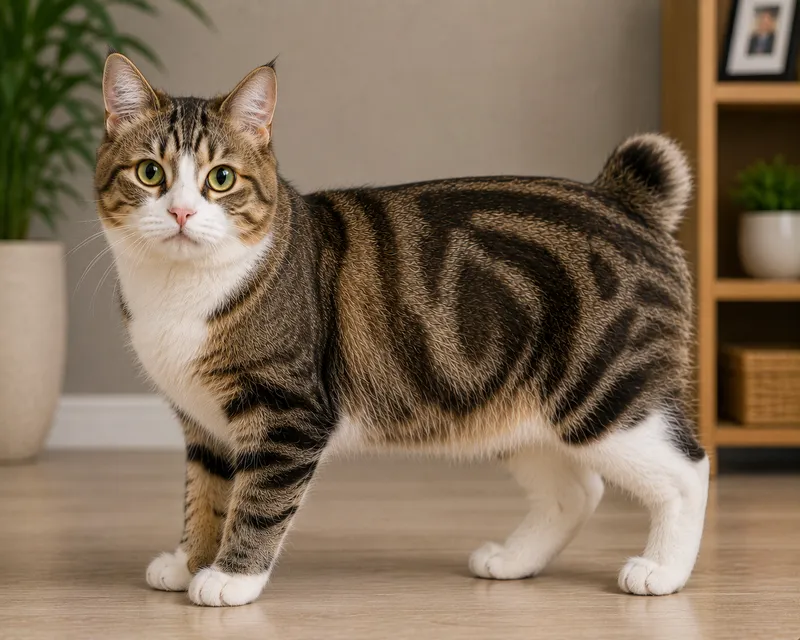
American Bobtail
The American Bobtail is a medium-to-large domestic cat developed in North America around a naturally shortened tail and a powerful, athletic body. Breed history often begins with a bobtailed brown tabby called Yodie in…
Recognized by: CFA · TICA
Size
Large
Weight
3.2–7.3 kg
Life span
11–15 years
Breed Traits
Energy Level
Moderate energy
Energy Level: 3 of 5
Low energyHigh energyChild / Family Compatibility
High compatibility
Child / Family Compatibility: 4 of 5
Low compatibilityHigh compatibilityGrooming Need
Light grooming need
Grooming Need: 2 of 5
Low maintenanceHigh maintenanceTrainability
Easy to train
Trainability: 4 of 5
Hard to trainEasy to trainApartment / Home Suitability
Fits apartments well
Apartment / Home Suitability: 4 of 5
Needs space / yardExcellent for apartmentsAlone-Time Tolerance
Half-day is hard
Alone-Time Tolerance: 2 of 5
Needs frequent companyHandles long alone timeFirst-Time Owner Suitability
Suitable for many first-timers
First-Time Owner Suitability: 4 of 5
Needs experienced ownerGreat for first-time ownersCompatibility with Other Pets
Generally gets along well with other pets
Compatibility with Other Pets: 4 of 5
Single-pet homes are a better fitHighly compatible with other animals
The American Bobtail is a medium-to-large domestic cat developed in North America around a naturally shortened tail and a powerful, athletic body. Breed history often begins with a bobtailed brown tabby called Yodie in the late 1960s, but the modern population was not built from that cat alone. Breeders incorporated unrelated bobtailed domestic cats from different parts of the United States and Canada to broaden the foundation and establish a consistent type.
The body is substantial and moderately long, with a broad chest, strong boning, prominent shoulder blades, and well-developed musculature. A broad modified-wedge head, pronounced brow, and large almost almond-shaped eyes create the characteristic alert or hunting expression. Despite its wild appearance, the American Bobtail is entirely domestic and recognized breed programs do not require wild-cat ancestry.
The tail must be clearly present but shorter than a typical domestic cat's tail. It may be straight, gently curved, slightly kinked, or marked by small bumps, and no two tails are identical. American Bobtails occur in shorthaired and longhaired forms and in many genetically possible colors and patterns; BondPals maintains separate Longhair and Shorthair Atlas records in addition to this breed-family page.
American Bobtails are generally affectionate, confident, adaptable, and closely involved with their households. Many form bonds with several family members rather than attaching exclusively to one person, and they often communicate with chirps, trills, clicks, and quiet meows.
They are intelligent, moderately active cats that frequently enjoy retrieving toys, food puzzles, scent-based games, and harness training. Their hunting-style play can be intense, but most do not require the constant high-speed activity associated with the most demanding athletic breeds. Daily interactive play and access to secure climbing and observation areas remain important.
Well-socialized individuals commonly live successfully with respectful children, compatible cats, and cat-friendly dogs. They often dislike repeated long periods of isolation, so a predictable routine and regular companionship are valuable. Temperament still varies between individuals, and gradual introductions are preferable whenever a new person or animal joins the home.
Coat care depends on hair length and seasonal density. Shorthaired American Bobtails usually benefit from weekly brushing, while longhaired cats may need brushing or combing once or twice a week with extra attention to the ruff, belly, britches, and tail. Both coat types have an undercoat and may shed more heavily with seasonal changes.
The tail should be handled gently and never pulled, straightened, or repeatedly manipulated. Its structure and flexibility vary between cats, and discomfort should not be dismissed as a normal consequence of the breed. Pain, swelling, skin irritation, sudden sensitivity, reduced movement, or difficulty keeping the tail area clean warrants veterinary assessment.
Daily care should include interactive play, stable climbing and scratching furniture, dental hygiene, nail trimming, clean litter facilities, and measured portions of a complete life-stage-appropriate diet. Because the breed is heavily muscled, body condition should be judged by hands-on assessment rather than body weight alone, while excess fat should still be avoided.
Published breed-wide health data for the American Bobtail remain limited, and no single disorder is established as affecting every line. The breed's shortened tail should nevertheless be evaluated carefully because bobtail phenotypes in domestic cats can arise through more than one genetic mechanism and may not carry identical clinical implications.
A published genetic study identified a TBXT, historically called T, short-tail variant in sampled American Bobtails that was also found in a Manx lineage. This does not prove that every American Bobtail carries the same variant or has Manx syndrome. CFA cautions that completely tailless American Bobtails may experience incontinence and that some tail-associated spinal or hip problems can occur, but reliable prevalence figures for the breed are not available.
Prospective owners should ask about family longevity, gait, spinal and tail comfort, urinary and bowel function, and any related cats born completely tailless. Breeding decisions should combine physical examination, pedigree and family history, mobility assessment, and veterinarian-guided testing; a tail-related DNA result does not guarantee overall health. This information is for general educational purposes and is not a substitute for diagnosis or treatment by a veterinarian.
Recognizing organizations
Independent registries that list this breed. Tap a badge to learn more.
These statuses reflect each registry’s recording and show systems. They are not a health, quality, or superiority score.
Frequently asked questions
Are American Bobtails good family cats?
American Bobtails are generally affectionate, adaptable, and interested in family activity. Well-socialized individuals often live successfully with respectful children, but children should never pull, bend, or play roughly with the shortened tail.
Do American Bobtails get along with other pets?
Many American Bobtails can live successfully with compatible cats and cat-friendly dogs after gradual introductions. Individual confidence, age, play style, and previous social experience remain more important than breed reputation alone.
Can an American Bobtail live in an apartment?
An American Bobtail can adapt well to apartment living when provided with daily play, sturdy climbing furniture, scratching areas, puzzle activities, and secure windows or balconies. Its substantial build means shelves and perches should be stable and appropriately sized.
Can American Bobtails be left alone during the day?
Many adults can manage ordinary short absences, but the breed is commonly people-oriented and may not thrive with frequent prolonged isolation. A predictable routine, varied enrichment, and dependable human or compatible animal companionship can help.
How much grooming does an American Bobtail need?
Shorthaired cats usually need weekly brushing, while longhaired American Bobtails may benefit from brushing or combing once or twice a week. Grooming needs can increase during seasonal shedding, especially around the ruff, belly, hindquarters, and tail.
What is the difference between American Bobtail, American Bobtail Longhair, and American Bobtail Shorthair?
They belong to the same breed family and share the same body type, temperament tendencies, and naturally shortened tail. BondPals keeps separate registry pages so the Longhair and Shorthair entries can describe their coat structure and grooming needs in greater detail.
Is the American Bobtail related to the bobcat?
No verified wild-cat ancestry is required to create the American Bobtail's appearance. The breed was developed from domestic cats with naturally shortened tails, and resemblance to a bobcat is visual rather than evidence of a recent wild hybrid.
What health checks are important for an American Bobtail?
There is no single DNA panel that provides complete breed-wide clearance. Ask about gait, spinal and tail comfort, urinary and bowel function, completely tailless relatives, family longevity, and veterinary records, and have any pain, weakness, incontinence, or mobility change assessed promptly.
More about American Bobtail
Pet profiles are coming soon. For now, keep exploring trusted breed knowledge in the Breed Guide.
Back to Breed Guide