

Pixiebob Longhair
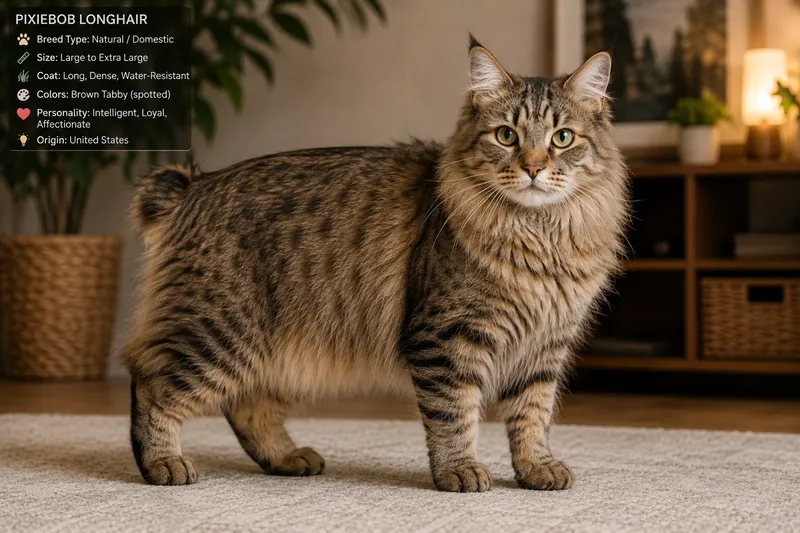
The Pixiebob Longhair is the long-coated form of the Pixiebob, a domestic breed developed in the Northwestern United States to resemble the North American bobcat while retaining the temperament of a companion cat. Breed…
Tanıyan kuruluşlar: TICA
Boyut
Büyük
Ağırlık
3.6–7.7 kg
Yaşam süresi
13–15 yıl
Irk Özellikleri
Enerji Seviyesi
Yüksek enerji
Enerji Seviyesi: 4 / 5
Düşük enerjiYüksek enerjiÇocuk / Aile Uyumu
Çok yüksek uyum
Çocuk / Aile Uyumu: 5 / 5
Düşük uyumYüksek uyumTüy Bakımı
Orta bakım ihtiyacı
Tüy Bakımı: 3 / 5
Az bakımYoğun bakımEğitilebilirlik
Çok kolay eğitilir
Eğitilebilirlik: 5 / 5
Zor eğitilirKolay eğitilirApartman / Ev Yaşamına Uygunluk
Apartmanda iyi uyum
Apartman / Ev Yaşamına Uygunluk: 4 / 5
Geniş alan / bahçe gerekirApartmana çok uygunYalnız Kalma Toleransı
Yarım gün zorlanır
Yalnız Kalma Toleransı: 2 / 5
Sürekli eşlik isterUzun yalnızlığa dayanırİlk Kez Sahiplenecekler İçin Uygunluk
Birçok ilk sahip için uygun
İlk Kez Sahiplenecekler İçin Uygunluk: 4 / 5
Deneyimli sahip gerekirİlk kez sahiplenmeye çok uygunDiğer Evcil Hayvanlarla Uyum
Çok yüksek uyum gösterir
Diğer Evcil Hayvanlarla Uyum: 5 / 5
Tek evcil hayvanlı ev daha uygunDiğer hayvanlarla çok uyumlu
The Pixiebob Longhair is the long-coated form of the Pixiebob, a domestic breed developed in the Northwestern United States to resemble the North American bobcat while retaining the temperament of a companion cat. Breed founder Carol Ann Brewer began working with distinctive short-tailed cats in Washington State during the 1980s. A female named Pixie became particularly influential, and Brewer named the developing breed Pixiebob in her memory.
Despite its deliberately wild-looking appearance and persistent folklore surrounding the breed's origins, the Pixiebob is treated as a domestic cat rather than a bobcat hybrid. TICA accepted the developing breed for Exhibition Status in 1994, advanced it through the new-breed programme, and granted Championship status beginning with the 1998 show season.
The Pixiebob is medium to large, substantially boned, muscular, and rangy, with a prominent brow, deep-set eyes, a broad muzzle and chin, large paws, and a naturally shortened tail. The desired overall impression is powerful and distinctly bobcat-like without sacrificing sound domestic-cat structure and movement. Polydactyl individuals are accepted under the TICA standard, with limits on the number of toes.
The Longhair has a medium-length coat that can reach approximately two inches, with longer belly hair and a softer, silkier texture than the shorthair form. Brown spotted tabby coloration, heavy ticking, facial markings, and a naturally shortened tail contribute to the characteristic appearance. BondPals maintains the shorthaired Pixiebob as a separate Atlas record.
Pixiebob Longhairs are generally described as intelligent, social, affectionate, confident, and strongly devoted to their families. Their combination of loyalty and trainability has led to the breed sometimes being described as doglike, although individual cats still vary considerably in sociability and independence.
Many enjoy retrieving toys, learning household routines, following familiar people, and training for a harness and leash. Interactive wand play, food puzzles, sturdy climbing furniture, and reward-based training provide useful outlets for their curiosity and moderate-to-high activity.
Well-socialized Pixiebobs generally have good potential to live with respectful children and compatible companion animals. TICA describes the breed as enjoying both family participation and relaxed time in the household. Some communicate through chirps, chitters, and other distinctive sounds rather than relying primarily on conventional meowing.
The medium-length double coat needs regular grooming to control loose hair and reduce tangling. Thorough brushing or combing at least weekly is appropriate for many Pixiebob Longhairs, with additional grooming during heavier seasonal shedding or whenever the softer coat begins to form knots.
The naturally shortened tail should remain mobile and comfortable. Owners should become familiar with the cat's normal tail movement, gait, posture, and jumping ability. A kinked or knotted-looking tail can occur within the breed, but pain, stiffness, swelling, skin irritation, or a change in mobility warrants veterinary assessment rather than being assumed to be normal.
Polydactyl individuals require every toe and claw to be identified and inspected. Extra claws may not contact scratching surfaces normally and can therefore become overgrown or curl toward adjacent skin. Routine care should also include dental hygiene, ear checks, nail trimming, clean litter facilities, daily interactive activity, sturdy scratching and climbing furniture, and maintenance of a healthy body condition.
Published breed-specific clinical research on the Pixiebob remains limited, and no single inherited disease is firmly established as a defining health problem of the entire breed. TICA currently describes the Pixiebob as generally healthy while emphasizing routine veterinary care and appropriate weight management. Limited published evidence should not be interpreted as proof that every individual or family line is free from inherited disease.
The breed's shortened tail and accepted polydactyly make functional physical assessment particularly important. Tail flexibility, spinal comfort, gait, paw structure, and every additional digit and claw should be evaluated individually. The presence of a short tail or extra toes does not by itself establish disease, but pain, neurologic abnormalities, abnormal weight bearing, recurrent claw problems, or impaired movement require veterinary investigation.
Prospective owners should request veterinary and family records covering cardiac and kidney health, mobility, spinal or tail abnormalities, paw and nail problems, reproductive outcomes, longevity, and causes of death. Genetic tests should be selected according to documented ancestry and disorders demonstrated within the particular breeding line rather than assuming that a broad commercial DNA panel provides complete Pixiebob health clearance. This information is for general educational purposes and is not a substitute for diagnosis or treatment by a veterinarian.
Tanıyan kuruluşlar
Bu ırkı listelerinde tutan bağımsız kayıt kuruluşları. Ayrıntı için rozete dokunun.
Bu statüler kuruluşların kayıt ve yarışma sistemlerindeki konumu gösterir; sağlık, kalite veya üstünlük puanı değildir.
Sık sorulan sorular
Is the Pixiebob Longhair part bobcat?
No verified bobcat ancestry is required for the breed, and the Pixiebob is treated as a domestic cat. Its breeding standard deliberately creates visual similarities to the North American bobcat while maintaining the temperament and characteristics of a domestic companion cat.
Are Pixiebob Longhairs good family cats?
They are generally social, affectionate, playful, and strongly devoted to familiar people. Well-socialized individuals can make excellent family companions when provided with regular interaction, enrichment, and respectful handling.
Are Pixiebob Longhairs good with children and other pets?
Many well-socialized Pixiebobs live successfully with respectful children and compatible companion animals. Introductions should still be gradual, and each cat's confidence, previous experience, and individual temperament should guide the process.
Can a Pixiebob Longhair live in an apartment?
Yes, provided the home offers enough usable space for this substantial cat, together with sturdy climbing furniture, large scratching surfaces, daily interactive play, enrichment, and appropriately sized litter and resting areas.
How much grooming does a Pixiebob Longhair need?
The medium-length double coat should generally be brushed or combed at least weekly, with additional grooming during periods of heavier shedding or whenever tangles begin to develop.
Can Pixiebob Longhairs have extra toes?
Yes. Polydactyly is accepted in the TICA Pixiebob standard, subject to its limits on toe number. Every extra toe and claw should be checked regularly because some additional claws receive little natural wear and may require more frequent trimming.
What is the difference between a Pixiebob Longhair and a Pixiebob?
They belong to the same breed group and share the same general body type, bobbed-tail characteristic, temperament tendencies, and breed history. The Pixiebob Longhair has a softer medium-length coat with longer belly hair, while the Pixiebob has the shorter woollier coat form.
What health screening should a Pixiebob Longhair breeder provide?
There is no single validated DNA panel that guarantees complete Pixiebob health. Ask for veterinary and family health records covering heart and kidney health, mobility, spinal and tail problems, paw and nail abnormalities, longevity, and causes of death, together with an explanation of any targeted testing used within the breeder's lines.
Pixiebob Longhair hakkında daha fazla
Pet profilleri yakında. Şimdilik güvenilir ırk bilgisine Irk Rehberi’nde devam edebilirsiniz.
Irk Rehberine Dön