Bu ırk rehberi şu an İngilizce sunuluyor. Bu dil için tam çeviri henüz hazır değil.
Tanıyan kuruluşlar
Bu ırkı listelerinde tutan bağımsız kayıt kuruluşları. Ayrıntı için rozete dokunun.
Bu statüler kuruluşların kayıt ve yarışma sistemlerindeki konumu gösterir; sağlık, kalite veya üstünlük puanı değildir.
Irk Özellikleri
Yüksek enerji
Yüksek uyum
Hafif bakım ihtiyacı
Kolay eğitilebilir
Orta — koşullara bağlı
Yarım gün zorlanır
Rehberlikle yönetilebilir
Genellikle diğer evcil hayvanlarla iyi anlaşır
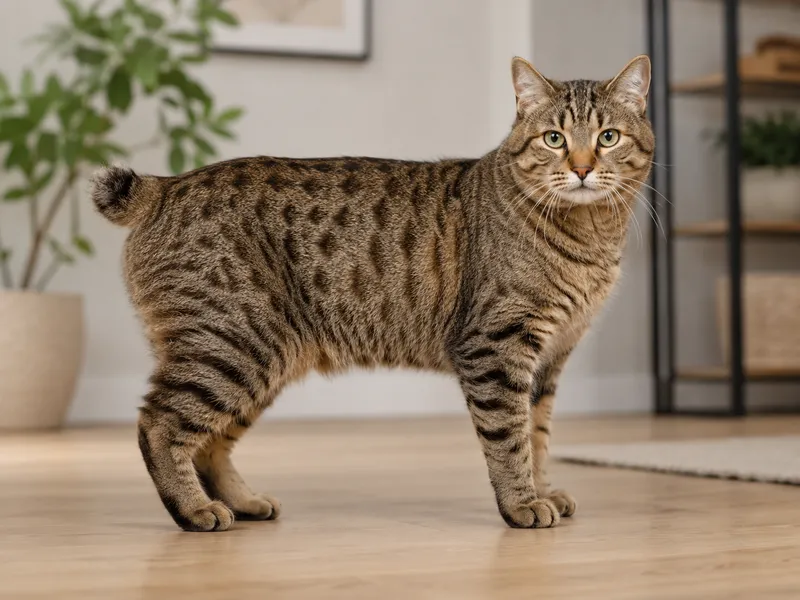
The Pixiebob is a modern North American breed developed in the Pacific Northwest to resemble the wild coastal bobcat while remaining a domestic companion cat. TICA's history traces the programme to bobtailed cats acquired by breeder Carol Ann Brewer in Washington State during the 1980s and to a female named Pixie, whose name became part of the breed's identity. A written standard followed in 1989, and TICA granted Championship status for the 1998 show season.
This is a medium-to-large, substantial cat with heavy boning, a muscular rangy body, a broad chest, and hind legs that are slightly longer than the forelegs. The head has an inverted-pear outline, a fleshy chin, a broad muzzle, heavily hooded eyes, and a prominent brow that contributes to the breed's wild-looking expression.
The Pixiebob registry entry generally represents the short-coated form, while Pixiebob Longhair is tracked separately by BondPals and TICA. The short coat is thick, double, and woolly in texture, with a brown spotted tabby pattern softened by ticking. The naturally shortened tail may be straight, curved, kinked, or knotted but should remain flexible and move naturally. Polydactyly is permitted but not required.
Are Pixiebobs good family cats?
Pixiebobs are generally social, affectionate, and interested in family activity. Well-socialized individuals may live successfully with respectful children, but adults should supervise handling and teach children not to pull the tail or play roughly with extra toes.
Do Pixiebobs get along with other pets?
Many Pixiebobs can live with compatible cats and cat-friendly dogs after gradual introductions. Individual confidence, age, play style, and previous experience remain important, and small prey animals should be protected from normal feline hunting behaviour.
Can a Pixiebob live in an apartment?
A Pixiebob can adapt to apartment living when provided with daily interactive play, sturdy climbing furniture, scratching areas, puzzle activities, and regular companionship. Its size and activity level make secure windows, balconies, shelves, and perches especially important.
Can Pixiebobs be left alone during the day?
Many adults can manage ordinary short absences, but frequent prolonged isolation may not suit this social breed. A predictable routine, varied enrichment, and dependable human or compatible animal companionship can help reduce boredom.
How much grooming does a Pixiebob need?
The short, dense double coat usually needs weekly brushing or combing, with more frequent attention during seasonal shedding. Polydactyl cats also need every claw checked and trimmed because some extra nails may not wear normally.
What is the difference between a Pixiebob and a Pixiebob Longhair?
They share the same breed type, temperament tendencies, shortened tail, and permitted polydactyly. The Pixiebob has a shorter woolly double coat, while the Pixiebob Longhair has a softer medium-length coat that generally requires more thorough grooming.
Is the Pixiebob part bobcat?
The breed was developed to resemble the North American bobcat, but wild ancestry is not required by the breed standard and visual similarity is not proof of hybrid origin. Registries treat the Pixiebob as a domestic cat breed.
What health checks are important for a Pixiebob?
There is no single test that provides complete breed-wide clearance. Ask about gait, tail and spinal comfort, urinary and bowel function, paw and nail structure, family longevity, known illnesses, and veterinary records; any pain, weakness, incontinence, or mobility change should be assessed promptly.
- Tür
- Cat
Pixiebob hakkında daha fazla
Pet profilleri ve genel hesaplar yakında açılacak. Şimdilik doğrulanmış ırk rehberlerini atlas’ta keşfedebilirsin.