Bu ırk rehberi şu an İngilizce sunuluyor. Bu dil için tam çeviri henüz hazır değil.
Tanıyan kuruluşlar
Bu ırkı listelerinde tutan bağımsız kayıt kuruluşları. Ayrıntı için rozete dokunun.
Bu statüler kuruluşların kayıt ve yarışma sistemlerindeki konumu gösterir; sağlık, kalite veya üstünlük puanı değildir.
Irk Özellikleri
Yüksek enerji
Yüksek uyum
Orta bakım ihtiyacı
Kolay eğitilebilir
Apartmanda iyi uyum
Yarım gün zorlanır
Yeni başlayanlar için zorlayıcı
Genellikle diğer evcil hayvanlarla iyi anlaşır
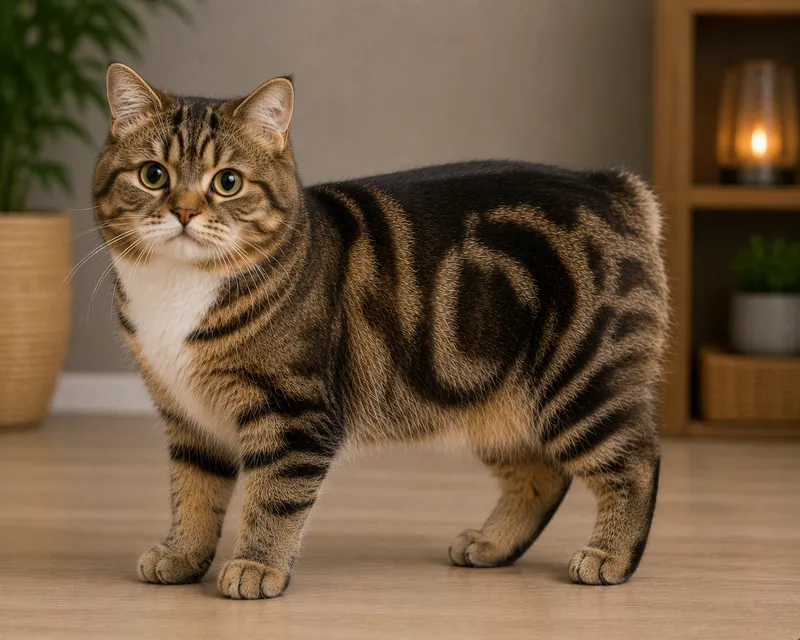
The Manx is a natural breed associated with the Isle of Man in the Irish Sea. Tailless and short-tailed cats became established in the island population through a dominant mutation, although the exact date and ancestry of the founding cats are uncertain. Manx cats appeared in early British cat shows and were among the breeds registered when CFA began in 1906.
A mature Manx is medium-sized, compact, muscular, and surprisingly heavy, with a broad chest, deep flanks, a rounded head, prominent cheeks, and hind legs that are longer than the forelegs. The back rises smoothly toward a broad rounded rump. A healthy Manx should move powerfully and normally; a persistent hopping gait, weakness, or reluctance to move is not a desirable breed characteristic.
Tail length ranges from completely tailless rumpy cats through rumpy risers and short-tailed stumpies to full-tailed longies. Coat and show classifications differ between registries: shorthaired cats are generally called Manx, while the longhaired form is often called Cymric or Longhair Manx. BondPals maintains separate Manx Shorthair and Manx Tailed records in addition to this breed-family page.
Are Manx cats good family pets?
Manx cats are generally affectionate, playful, and strongly involved with their households. Families should provide gentle handling, regular activity, and careful observation for mobility or elimination problems linked to severe tail reduction.
Are Manx cats good with children?
Many well-socialized Manx live successfully with respectful children. Children should support the cat's body properly and must never poke a tailless rump or pull, bend, or repeatedly handle a partial tail.
Do Manx cats get along with other pets?
Many Manx adapt well to compatible cats and cat-friendly dogs after gradual introductions. Their hunting instincts may make birds, rodents, and other small animals unsuitable companions without secure separation.
Can a Manx cat live in an apartment?
A healthy Manx can adapt well to apartment living when given daily play, sturdy climbing options, scratching areas, puzzle activities, and regular companionship. Non-slip surfaces and accessible litter trays are especially useful for cats with mobility limitations.
Can Manx cats be left alone during the day?
Many adults can manage ordinary short absences, but frequent prolonged isolation is not ideal for this people-oriented breed. A predictable routine and varied enrichment can help, although they do not replace dependable daily interaction.
What do rumpy, rumpy riser, stumpy, and longy mean in Manx cats?
These informal terms describe different tail lengths. A rumpy has no visible tail, a rumpy riser has a small rise of bone or cartilage, a stumpy has a short partial tail, and a longy has a near-normal or full-length tail.
What is the difference between a Manx and a Cymric?
They share the same body type, tail genetics, and general temperament tendencies. TICA and FIFe use Manx for the shorthaired form and Cymric for the longhaired form, while CFA includes both coat lengths within its Manx standard.
Does every tailless Manx develop Manx syndrome?
No. Some tailless Manx remain clinically comfortable, while others develop congenital spinal, neurological, urinary, or bowel problems. Because exact severity cannot be predicted from appearance alone, prospective owners should request family history, veterinary records, and evidence of normal mobility and elimination.
- Tür
- Cat
Manx hakkında daha fazla
Pet profilleri ve genel hesaplar yakında açılacak. Şimdilik doğrulanmış ırk rehberlerini atlas’ta keşfedebilirsin.