Bu ırk rehberi şu an İngilizce sunuluyor. Bu dil için tam çeviri henüz hazır değil.
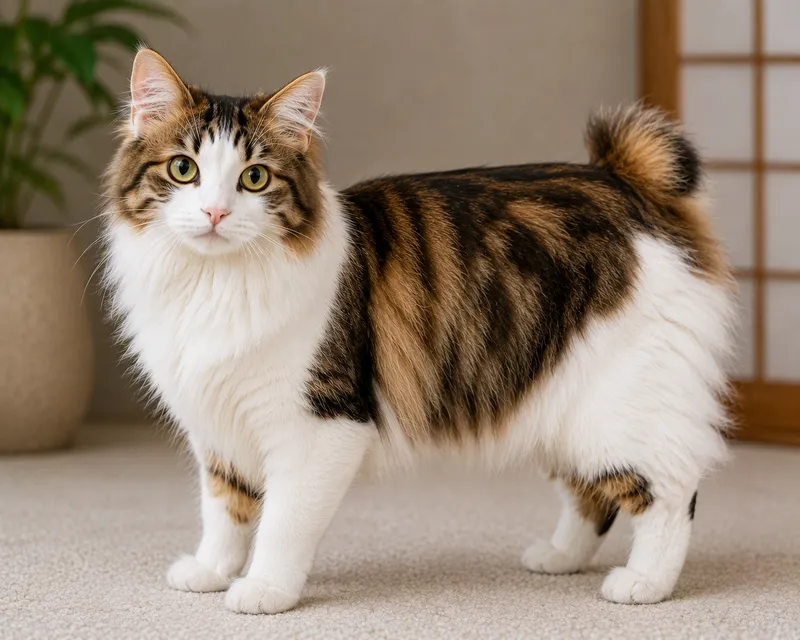
Japanese Bobtail Longhair
Medium
2.3–4.5 kg
9–13 yıl
Tanıyan kuruluşlar
Bu ırkı listelerinde tutan bağımsız kayıt kuruluşları. Ayrıntı için rozete dokunun.
Bu statüler kuruluşların kayıt ve yarışma sistemlerindeki konumu gösterir; sağlık, kalite veya üstünlük puanı değildir.
Irk Özellikleri
Çok enerjik
Çok yüksek uyum
Orta bakım ihtiyacı
Çok kolay eğitilir
Apartmanda iyi uyum
Yarım gün zorlanır
Birçok ilk sahip için uygun
Çok yüksek uyum gösterir
The Japanese Bobtail Longhair is the long-coated form of the Japanese Bobtail, a naturally bobtailed cat associated with Japan and represented in Japanese art and written records for centuries. The modern pedigree population developed internationally after Japanese Bobtails reached North America in 1968, while longhaired cats were incorporated into formal show recognition later than their shorthaired relatives.
This is a medium-sized, elegant, and athletic cat with long clean lines, firm musculature, high cheekbones, large expressive eyes, and hind legs that are slightly longer than the forelegs. Its defining tail is clearly present but shortened, with curves, angles, kinks, or combinations of these structures beneath a plume of longer hair that creates a chrysanthemum-like pom-pom.
The coat ranges from medium-long to long and is soft and silky, with little noticeable undercoat in the mature adult. A frontal ruff, longer hindquarter furnishings, ear tufts, toe tufts, and a coat that lengthens gradually toward the rump may be present. Many colours and patterns occur, while red, black, and white mi-ke remains especially associated with the breed.
Are Japanese Bobtail Longhairs good family cats?
Japanese Bobtail Longhairs are generally affectionate, playful, and strongly involved in family life. Well-socialized individuals commonly live successfully with respectful children who understand gentle handling and do not pull or manipulate the cat's tail.
Do Japanese Bobtail Longhairs get along with other pets?
Many live successfully with compatible cats and cat-friendly dogs after gradual introductions. Individual confidence, play intensity, age, and previous experience still matter, and interactions with small prey animals should be managed carefully.
Can a Japanese Bobtail Longhair live in an apartment?
This variety can adapt well to apartment living when provided with stable climbing furniture, energetic daily play, puzzle activities, scratching areas, and regular companionship. Secure windows and balconies are important for an agile and inquisitive cat.
Can Japanese Bobtail Longhairs be left alone during the day?
Many adults can manage ordinary short absences, but frequent prolonged isolation is not ideal for this active and people-oriented cat. A predictable routine, enrichment, and dependable human or compatible animal companionship can help reduce boredom.
How much grooming does a Japanese Bobtail Longhair need?
Combing once or twice a week is usually sufficient because the silky coat has little noticeable undercoat. The tail plume, belly, hindquarters, armpits, and areas behind the ears may need extra attention, especially during seasonal shedding.
What is the difference between a Japanese Bobtail Longhair and a Japanese Bobtail Shorthair?
Both share the same breed type, temperament tendencies, and naturally bobbed tail. The Longhair has a medium-long to long silky coat with a fuller tail plume, hindquarter furnishings, and possible ruff and tufts, while the Shorthair has a closer, shorter coat that usually needs less grooming.
Is the Japanese Bobtail Longhair a separate breed or a coat variety?
Classification depends on the registry. TICA lists Japanese Bobtail Longhair separately within its championship system, CFA recognises the longhaired form within Japanese Bobtail, and FIFe lists it as a non-recognised sister variety of the recognised Japanese Bobtail Shorthair.
Does the Japanese Bobtail Longhair have the same tail-related health risk as a Manx?
The Japanese Bobtail tail is associated with HES7, while the Manx phenotype is linked to different TBXT variants. Research has not established Manx syndrome as a defining Japanese Bobtail problem, but pain, weakness, abnormal gait, urinary difficulty, constipation, or tail sensitivity still requires veterinary assessment.
- Tür
- Cat
Japanese Bobtail Longhair hakkında daha fazla
Pet profilleri ve genel hesaplar yakında açılacak. Şimdilik doğrulanmış ırk rehberlerini atlas’ta keşfedebilirsin.