

Donskoy
The Donskoy is a Russian hairless breed whose modern history begins in Rostov-on-Don in 1987, when a rescued female named Varvara began losing her coat and later produced kittens with similar hair-loss patterns.…
Tanıyan kuruluşlar: FIFe · TICA
Boyut
Orta
Ağırlık
2.7–5.5 kg
Yaşam süresi
12–15 yıl
Irk Özellikleri
Enerji Seviyesi
Çok enerjik
Enerji Seviyesi: 5 / 5
Düşük enerjiYüksek enerjiÇocuk / Aile Uyumu
Yüksek uyum
Çocuk / Aile Uyumu: 4 / 5
Düşük uyumYüksek uyumTüy Bakımı
Yüksek bakım ihtiyacı
Tüy Bakımı: 4 / 5
Az bakımYoğun bakımEğitilebilirlik
Çok kolay eğitilir
Eğitilebilirlik: 5 / 5
Zor eğitilirKolay eğitilirApartman / Ev Yaşamına Uygunluk
Apartmana çok uygun
Apartman / Ev Yaşamına Uygunluk: 5 / 5
Geniş alan / bahçe gerekirApartmana çok uygunYalnız Kalma Toleransı
Çok kısa yalnızlık (birkaç saat)
Yalnız Kalma Toleransı: 1 / 5
Sürekli eşlik isterUzun yalnızlığa dayanırİlk Kez Sahiplenecekler İçin Uygunluk
Rehberlikle yönetilebilir
İlk Kez Sahiplenecekler İçin Uygunluk: 3 / 5
Deneyimli sahip gerekirİlk kez sahiplenmeye çok uygunDiğer Evcil Hayvanlarla Uyum
Genellikle diğer evcil hayvanlarla iyi anlaşır
Diğer Evcil Hayvanlarla Uyum: 4 / 5
Tek evcil hayvanlı ev daha uygunDiğer hayvanlarla çok uyumlu
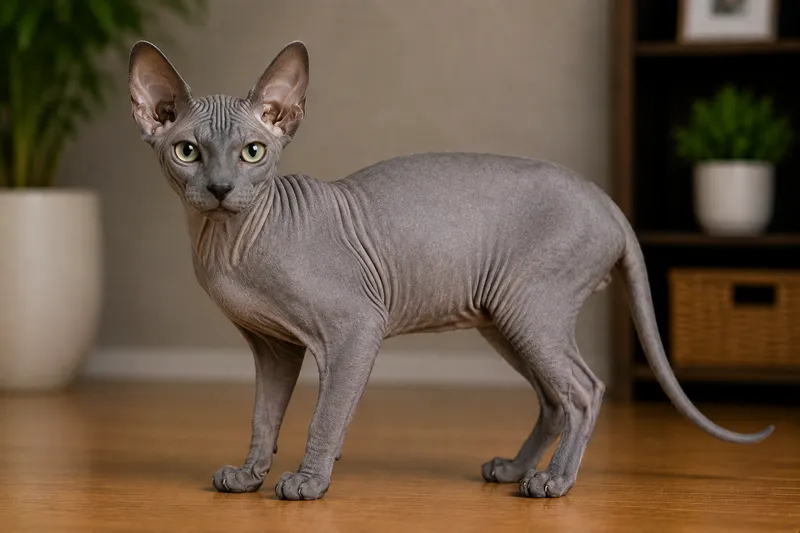
The Donskoy is a Russian hairless breed whose modern history begins in Rostov-on-Don in 1987, when a rescued female named Varvara began losing her coat and later produced kittens with similar hair-loss patterns. Breeders developed those descendants into a distinct breed. TICA uses the name Donskoy, while FIFe recognises the same breed as the Don Sphynx.
This is a medium-sized, solid, muscular cat with strong boning, a wedge-shaped head, almond-shaped eyes, prominent cheekbones and eyebrows, large ears, and long, distinctive toes. The skin is elastic and characteristically wrinkled, especially around the head, neck, shoulders, legs, and belly.
Donskoys can occur in several coat presentations. TICA describes Rubber Bald, Flock, Velour, and Brush coats; some kittens are born hairless, while others progressively lose part or most of their coat. Coat coverage can change with age and season, so a Donskoy should not be assumed to remain completely bald throughout life.
Donskoys are generally active, intelligent, curious, affectionate, and strongly social. Many want to participate in household routines, seek frequent physical contact, explore new objects, and engage readily with interactive toys or training games.
They usually benefit from daily play, climbing opportunities, food puzzles, and learning activities. Their people-oriented nature can make them responsive to consistent reward-based training, but individual confidence and motivation still vary.
Well-socialized Donskoys often live successfully with respectful children, compatible cats, and cat-friendly dogs. They are poorly suited to repeated long periods of isolation and generally do best in homes where dependable human or animal companionship is available.
Hairlessness does not make the Donskoy maintenance-free. Skin oils and debris can accumulate because there is little or no coat to absorb them, so many cats need regular gentle wiping and periodic bathing based on their individual skin condition. Excessive washing or unsuitable products can irritate the skin, so persistent oiliness, scaling, redness, odour, or soreness should be discussed with a veterinarian.
Sparse or absent hair provides less protection from cold and strong sunlight. Keep the cat indoors, provide warm resting places without overheating, limit intense direct sun exposure, and consult a veterinarian before using any topical skin or sun-protection product. Ears, nail folds, toes, and wrinkles should be checked regularly for wax, debris, irritation, or infection.
Daily care should also include vigorous interactive play, stable climbing and scratching furniture, dental hygiene, nail trimming, clean litter facilities, and measured portions of a complete life-stage-appropriate diet. Regular veterinary examinations are particularly useful for monitoring skin, eyes, oral health, body condition, and any changes in coat or comfort.
The Donskoy's hereditary hypotrichosis is reported as an autosomal incompletely dominant trait, but its precise causal variant has not yet been established. The KRT71 variant responsible for the classic Sphynx hairless phenotype has been ruled out as the explanation for Donskoy hairlessness, so a Sphynx KRT71 result should not be treated as a Donskoy coat or health clearance.
A recessive HPS5 c.2571-1G>A splice-site variant has been associated with a Donskoy "pink-eye" form of oculocutaneous albinism. Reported affected cats had light-brown skin, yellow irises with a red-eye effect, reduced visual acuity, and slightly prolonged bleeding time, but the variant was identified in a particular inbred pedigree and its frequency in the wider Donskoy population is unknown. HPS5 testing may therefore be relevant in affected or known-risk family lines rather than evidence that the condition is universal in the breed.
A small 2024 case series of 11 Eastern European hairless cats with chronic figurate erythema included seven Donskoys, showing that this waxing-and-waning skin disorder can occur in the breed but not establishing its population prevalence. Prospective owners should ask about persistent skin disease, eye findings, unusual bleeding, family longevity, and any line-specific genetic testing, while breeders should combine test results with veterinary examination and family history. This information is for general educational purposes and is not a substitute for diagnosis or treatment by a veterinarian.
Tanıyan kuruluşlar
Bu ırkı listelerinde tutan bağımsız kayıt kuruluşları. Ayrıntı için rozete dokunun.
Bu statüler kuruluşların kayıt ve yarışma sistemlerindeki konumu gösterir; sağlık, kalite veya üstünlük puanı değildir.
Sık sorulan sorular
Are Donskoys good family cats?
Donskoys are generally affectionate, interactive, and highly involved with household life. They suit families that can provide dependable companionship, daily play, and consistent skin and temperature care.
Are Donskoys good with children?
Many well-socialized Donskoys can live successfully with respectful children. Adults should supervise young children, prevent rough handling of exposed skin, and make sure the cat can leave whenever it wants quiet.
Do Donskoys get along with other pets?
They often have a high potential to live with compatible cats and cat-friendly dogs after gradual introductions. A suitable companion may be especially valuable in homes where people are absent for part of the day, although individual temperament still matters.
Can a Donskoy live in an apartment?
A Donskoy can adapt very well to apartment living when the home provides daily interactive play, climbing furniture, scratching areas, warm resting places, and secure windows or balconies. Indoor living also makes temperature and sun exposure easier to manage.
Can Donskoys be left alone during the day?
Ordinary short absences are manageable for many adults, but frequent prolonged isolation is a poor match for this highly social breed. A predictable routine, enrichment, and compatible human or animal companionship are important.
How much grooming does a Donskoy need?
A hairless Donskoy still needs regular skin, ear, nail-fold, and wrinkle care. Gentle wiping and periodic bathing should be based on the individual cat's oil and skin condition, because over-cleaning can also cause irritation.
What is the difference between a Donskoy, a Sphynx, and a Peterbald?
The Donskoy is a distinct Russian breed whose hairlessness is inherited differently from the best-established KRT71-associated Sphynx phenotype. The Peterbald was later developed using Donskoy and Oriental Shorthair ancestry and has a more elongated Oriental-style body and head.
What health screening should a Donskoy breeder provide?
Ask for veterinary records, a documented pedigree, family history of skin and eye problems, unusual bleeding, longevity, and an explanation of any genetic tests used. HPS5 testing is relevant to the documented pink-eye albinism variant in risk lines, but no single DNA result provides complete Donskoy health clearance.
Donskoy hakkında daha fazla
Pet profilleri yakında. Şimdilik güvenilir ırk bilgisine Irk Rehberi’nde devam edebilirsiniz.
Irk Rehberine Dön