Bu ırk rehberi şu an İngilizce sunuluyor. Bu dil için tam çeviri henüz hazır değil.
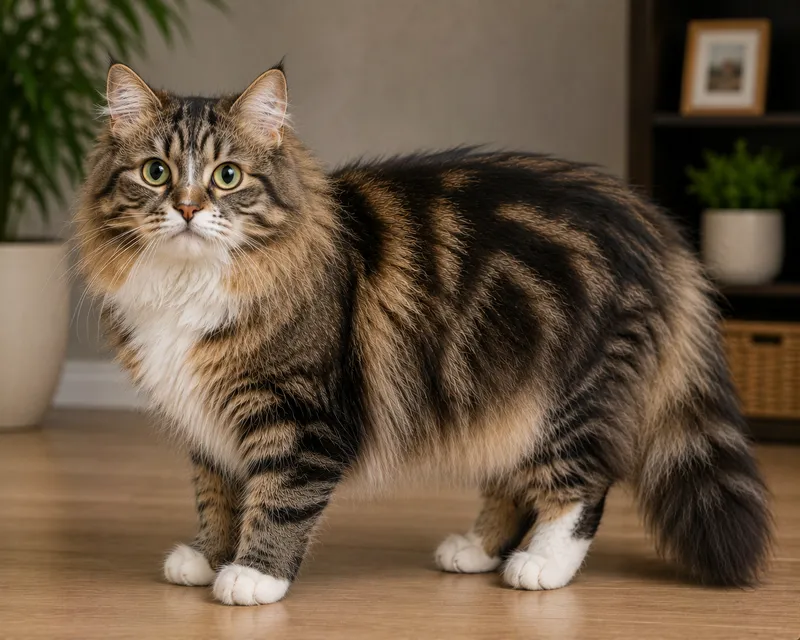
Domestic Longhair
Medium
3–6.5 kg
12–18 yıl
Tanıyan kuruluşlar
Bu ırkı listelerinde tutan bağımsız kayıt kuruluşları. Ayrıntı için rozete dokunun.
Bu statüler kuruluşların kayıt ve yarışma sistemlerindeki konumu gösterir; sağlık, kalite veya üstünlük puanı değildir.
Irk Özellikleri
Orta enerji
Orta uyum
Yüksek bakım ihtiyacı
Orta eğitilebilirlik
Apartmanda iyi uyum
Tipik iş günü idare eder
Rehberlikle yönetilebilir
Doğru sosyalleştirmeyle uyum sağlayabilir
Domestic Longhair describes non-pedigree or mixed-ancestry domestic cats whose coats are long enough to require more maintenance than a typical shorthair coat. It is a descriptive registry and shelter category rather than a single standardized breed, so these cats do not share one documented ancestry, body type, color, or inherited temperament.
Individuals may be small or large, fine-boned or substantial, and can have almost any feline coat color, pattern, eye color, and facial shape. Coat texture also varies: some have a light, silky covering with little undercoat, while others develop a dense double coat, a neck ruff, hindquarter furnishings, toe tufts, and a heavily plumed tail.
A long coat alone does not make a cat a Persian, Maine Coon, Norwegian Forest Cat, or another pedigree breed. Without reliable pedigree documentation, resemblance to a recognized breed should be described only as a visual similarity. Domestic Longhairs may arise from generations of random-bred cats or from mixed ancestry that includes one or more pedigree lines.
Is a Domestic Longhair a recognized cat breed?
Domestic Longhair is usually a descriptive category for a non-pedigree or mixed-ancestry cat, not a single standardized breed. FIFe maintains a House Cat Longhair show category, while other major registries generally place comparable cats in household-pet competition rather than a pedigree breed division.
How can I tell whether my longhaired cat belongs to a pedigree breed?
Coat length, color, size, or resemblance to a known breed cannot confirm ancestry. Reliable pedigree records from a recognized registry are needed to identify a cat as a specific pedigree breed; without them, Domestic Longhair is usually the more accurate description.
Are Domestic Longhairs good family cats?
Many are affectionate and adaptable family companions, but the category does not predict one temperament. Suitability depends on the individual cat's socialization, handling preferences, health, activity level, and ability to retreat from unwanted attention.
Do Domestic Longhairs get along with children and other pets?
Some live very successfully with respectful children, cats, or cat-friendly dogs, while others prefer a quieter or single-pet home. Slow introductions, supervision, separate resources, and attention to the cat's body language are more useful than assumptions based on coat length.
Can a Domestic Longhair live in an apartment?
Most can adapt to apartment living when the home provides play, vertical territory, scratching surfaces, hiding places, clean litter facilities, and secure windows or balconies. The cat's individual energy level and previous lifestyle should guide the amount of enrichment required.
How often should a Domestic Longhair be groomed?
Many need combing several times a week, while dense, soft, or mat-prone coats may require daily care. Grooming frequency should increase during heavy shedding and whenever tangles begin forming around the chest, armpits, belly, hindquarters, or tail.
Are hairballs normal in Domestic Longhairs?
Occasional hair passage can occur, and regular grooming may reduce swallowed loose hair. Frequent vomiting, repeated unproductive retching, appetite loss, constipation, lethargy, or abdominal discomfort requires veterinary assessment rather than routine hairball treatment without a diagnosis.
What health screening does a Domestic Longhair need?
There is no universal breed-specific DNA panel because ancestry varies widely. Screening should be based on physical examination, age, family or pedigree information when available, lifestyle, previous outdoor exposure, and any clinical signs identified by a veterinarian.
- Tür
- Cat
Domestic Longhair hakkında daha fazla
Pet profilleri ve genel hesaplar yakında açılacak. Şimdilik doğrulanmış ırk rehberlerini atlas’ta keşfedebilirsin.