

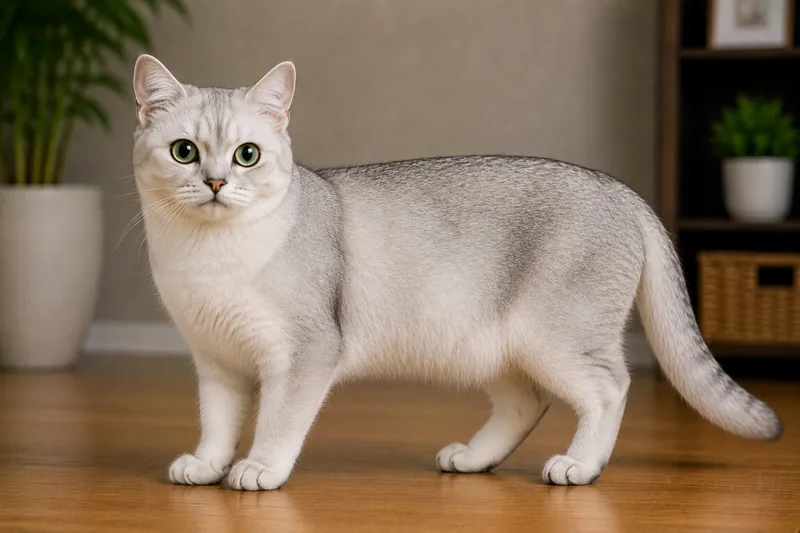
Burmilla Shorthair
The Burmilla Shorthair is the original short-coated form of the Burmilla, a breed created in Britain after an accidental 1981 mating between a Chinchilla Persian male, Jemari Sanquist, and a lilac Burmese female,…
Tanıyan kuruluşlar: CFA · FIFe · +2
Boyut
Orta
Ağırlık
3.6–5.4 kg
Yaşam süresi
15–18 yıl
Irk Özellikleri
Enerji Seviyesi
Orta enerji
Enerji Seviyesi: 3 / 5
Düşük enerjiYüksek enerjiÇocuk / Aile Uyumu
Yüksek uyum
Çocuk / Aile Uyumu: 4 / 5
Düşük uyumYüksek uyumTüy Bakımı
Hafif bakım ihtiyacı
Tüy Bakımı: 2 / 5
Az bakımYoğun bakımEğitilebilirlik
Kolay eğitilebilir
Eğitilebilirlik: 4 / 5
Zor eğitilirKolay eğitilirApartman / Ev Yaşamına Uygunluk
Apartmana çok uygun
Apartman / Ev Yaşamına Uygunluk: 5 / 5
Geniş alan / bahçe gerekirApartmana çok uygunYalnız Kalma Toleransı
Yarım gün zorlanır
Yalnız Kalma Toleransı: 2 / 5
Sürekli eşlik isterUzun yalnızlığa dayanırİlk Kez Sahiplenecekler İçin Uygunluk
Birçok ilk sahip için uygun
İlk Kez Sahiplenecekler İçin Uygunluk: 4 / 5
Deneyimli sahip gerekirİlk kez sahiplenmeye çok uygunDiğer Evcil Hayvanlarla Uyum
Çok yüksek uyum gösterir
Diğer Evcil Hayvanlarla Uyum: 5 / 5
Tek evcil hayvanlı ev daha uygunDiğer hayvanlarla çok uyumlu
The Burmilla Shorthair is the original short-coated form of the Burmilla, a breed created in Britain after an accidental 1981 mating between a Chinchilla Persian male, Jemari Sanquist, and a lilac Burmese female, Bambino Lilac Faberge. Their four female kittens were all shorthaired and black shaded silver and became the foundation of the developing breed.
This is a medium-sized, elegant but muscular cat with a gently rounded head, a short broad muzzle, medium-to-large ears, expressive eyes, slender but well-boned legs, and a balanced body that should be neither cobby nor extremely Oriental. The eyes are especially important to the characteristic expression and mature toward shades of green.
The short coat is fine, dense, silky, and smooth-lying with enough undercoat to give it slight lift. Shading or shell tipping creates the characteristic sparkling appearance, with accepted colours varying between registries. Registry terminology also differs: CFA recognises Shorthair and Longhair divisions, TICA uses Burmilla for the shorthaired form within its BM/BML breed group, FIFe's BML code refers to its short-coated Burmilla breed, and GCCF classifies Burmilla as the shaded variety of the Asian group.
Burmilla Shorthairs are generally affectionate, sociable, inquisitive, and playful. Their temperament reflects a combination of the outgoing Burmese background and the more relaxed Chinchilla Persian influence, producing a cat that often enjoys interaction without being relentlessly intense.
Many remain playful into adulthood and enjoy climbing, retrieving, interactive toys, food puzzles, and short reward-based training sessions. They are intelligent enough to learn household routines quickly and usually benefit from daily mental stimulation as well as physical play.
Well-socialized Burmilla Shorthairs commonly live successfully with respectful children, compatible cats, and cat-friendly dogs. They tend to enjoy being part of family activity and usually prefer dependable companionship to repeated long periods of isolation.
The short silky coat is low-maintenance compared with the longhaired form. Brushing or combing about once a week is sufficient for many cats and helps remove loose hair while preserving the smooth, glossy texture. Grooming can be increased during heavier seasonal shedding.
Routine coat care is also an opportunity to check the skin, ears, claws, mouth, and body condition. Dental hygiene, nail trimming, clean litter facilities, and regular veterinary examinations should form part of the normal care routine.
Provide daily interactive play, stable climbing and scratching furniture, puzzle activities, and measured portions of a complete life-stage-appropriate diet. Because the breed combines a compact muscular feel with a soft coat, healthy body condition should be assessed by muscle and fat cover rather than appearance alone.
An inherited form of hypokalaemic polymyopathy associated with a recessive WNK4 variant is relevant to the Burmilla family. Veterinary genetics laboratories specifically list Burmilla as appropriate for testing. Affected cats can experience episodes of low blood potassium accompanied by skeletal muscle weakness, while carriers are generally clinically unaffected but can pass the variant to offspring.
The dominant PKD1 variant associated with hereditary polycystic kidney disease is also considered appropriate for testing in Burmillas because of their Chinchilla Persian ancestry. A positive result predicts inheritance of this specific form of PKD, whereas a negative result excludes the tested PKD1 variant but does not rule out every possible kidney disorder. Test availability should not be interpreted as evidence that either disorder occurs at a high frequency in every Burmilla Shorthair population.
Prospective owners should request documented WNK4 hypokalemia and PKD1 results where relevant, together with veterinary records and family information covering episodes of weakness, kidney health, longevity, and causes of death. Breeders should combine DNA results with clinical examination, pedigree management, and attention to genetic diversity rather than treating a genetic panel as complete health clearance. This information is for general educational purposes and is not a substitute for diagnosis or treatment by a veterinarian.
Tanıyan kuruluşlar
Bu ırkı listelerinde tutan bağımsız kayıt kuruluşları. Ayrıntı için rozete dokunun.
Bu statüler kuruluşların kayıt ve yarışma sistemlerindeki konumu gösterir; sağlık, kalite veya üstünlük puanı değildir.
CFAŞampiyona (Championship)https://cfa.org/breed/burmilla/ FIFeTam tanınmış (Fully recognised)https://fifeweb.org/cats/breeds/ GCCFŞampiyona statüsü (Championship status)Burmilla (Asian Shaded) — Şampiyona statüsühttps://www.gccfcats.org/getting-a-cat/choosing/cat-breeds/asian/ TICAŞampiyona (Championship)https://tica.org/breed/burmilla/
Sık sorulan sorular
Are Burmilla Shorthairs good family cats?
Burmilla Shorthairs are generally affectionate, playful, and interested in everyday family life. They often suit households that want an interactive companion without the extreme activity level of some highly energetic breeds.
Are Burmilla Shorthairs good with children?
Many well-socialized Burmilla Shorthairs live successfully with respectful children. Adults should supervise younger children, encourage gentle handling, and make sure the cat can leave whenever it no longer wants interaction.
Do Burmilla Shorthairs get along with other pets?
They generally have high potential to live with compatible cats and cat-friendly dogs after gradual introductions. Separate food, water, litter, hiding, and resting resources help reduce competition while the animals become familiar with one another.
Can a Burmilla Shorthair live in an apartment?
Yes. Burmilla Shorthairs can adapt very well to apartment life when provided with daily play, climbing furniture, scratching surfaces, puzzle activities, and secure windows or balconies.
Can Burmilla Shorthairs be left alone during the day?
Many adults can manage ordinary periods alone when their routine is predictable. Frequent prolonged isolation is less suitable for this sociable breed, and environmental enrichment does not completely replace regular human or compatible animal companionship.
How much grooming does a Burmilla Shorthair need?
Weekly brushing or combing is sufficient for many individuals because the short coat is fine, silky, and relatively easy to maintain. More frequent grooming may be useful during seasonal shedding.
What is the difference between a Burmilla Shorthair and a Burmilla Longhair?
Both belong to the same Burmilla family and share the same fundamental history, body type, temperament tendencies, and major health-screening considerations. The Shorthair has a short dense silky coat, while the Longhair has a semi-long coat with more pronounced feathering, britches, bib, and tail plume.
What health screening should a Burmilla Shorthair breeder provide?
Ask for documented WNK4 hypokalemia and PKD1 results where those variants are relevant to the breeding programme, together with veterinary and family health records. Information about kidney health, episodes of muscle weakness, longevity, and causes of death remains important because no DNA panel guarantees complete health.
Burmilla Shorthair hakkında daha fazla
Pet profilleri yakında. Şimdilik güvenilir ırk bilgisine Irk Rehberi’nde devam edebilirsiniz.
Irk Rehberine Dön