

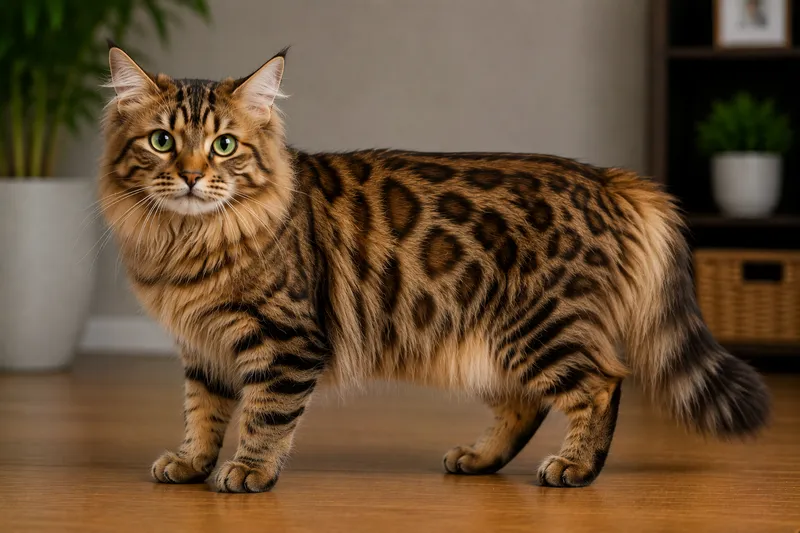
Bengal Longhair
The Bengal Longhair is the long-coated form of the Bengal and is also commonly called the Cashmere Bengal. Longhaired kittens have occurred within Bengal breeding lines since the breed's early development, but the coat…
Tanıyan kuruluşlar: CFA · TICA
Boyut
Orta
Ağırlık
2.7–6.8 kg
Yaşam süresi
12–20 yıl
Irk Özellikleri
Enerji Seviyesi
Çok enerjik
Enerji Seviyesi: 5 / 5
Düşük enerjiYüksek enerjiÇocuk / Aile Uyumu
Yüksek uyum
Çocuk / Aile Uyumu: 4 / 5
Düşük uyumYüksek uyumTüy Bakımı
Yüksek bakım ihtiyacı
Tüy Bakımı: 4 / 5
Az bakımYoğun bakımEğitilebilirlik
Çok kolay eğitilir
Eğitilebilirlik: 5 / 5
Zor eğitilirKolay eğitilirApartman / Ev Yaşamına Uygunluk
Orta — koşullara bağlı
Apartman / Ev Yaşamına Uygunluk: 3 / 5
Geniş alan / bahçe gerekirApartmana çok uygunYalnız Kalma Toleransı
Yarım gün zorlanır
Yalnız Kalma Toleransı: 2 / 5
Sürekli eşlik isterUzun yalnızlığa dayanırİlk Kez Sahiplenecekler İçin Uygunluk
Yeni başlayanlar için zorlayıcı
İlk Kez Sahiplenecekler İçin Uygunluk: 2 / 5
Deneyimli sahip gerekirİlk kez sahiplenmeye çok uygunDiğer Evcil Hayvanlarla Uyum
Genellikle diğer evcil hayvanlarla iyi anlaşır
Diğer Evcil Hayvanlarla Uyum: 4 / 5
Tek evcil hayvanlı ev daha uygunDiğer hayvanlarla çok uyumlu
The Bengal Longhair is the long-coated form of the Bengal and is also commonly called the Cashmere Bengal. Longhaired kittens have occurred within Bengal breeding lines since the breed's early development, but the coat length was historically less accepted in the show ring. TICA granted the longhaired form Championship recognition in 2017.
Like the shorthair Bengal, the Bengal Longhair descends from a breed programme that combined domestic cats with the Asian leopard cat, Prionailurus bengalensis. Modern pedigree Bengals are bred as domestic cats, and the desired adult has a muscular, athletic body, substantial boning, strong hindquarters, a broad modified wedge-shaped head, relatively small rounded ears, large oval eyes, and a thick medium-length tail.
The principal difference is the coat. It is medium to long, fine, soft, silky, and flowing rather than woolly, with a plumed tail and potentially longer hair around the neck and hindquarters. The characteristic Bengal spotted, rosetted, or marbled pattern should remain clearly visible through the longer coat, and some individuals also display the reflective effect known as glitter.
Bengal Longhairs are generally energetic, intelligent, curious, confident, and strongly interested in their surroundings. Many seek frequent interaction with their people and enjoy climbing, chasing, retrieving, exploring, puzzle feeders, and reward-based training.
Their activity level is substantially more demanding than their glamorous coat may suggest. A Bengal Longhair commonly looks for vertical territory and complex activities and may create its own entertainment when insufficiently challenged. Many can learn harness walking, target training, tricks, and household routines quickly.
Well-socialized individuals can live successfully with respectful children, compatible cats, and active cat-friendly dogs. Their strong chase behaviour means introductions to smaller animals require particular caution. They generally thrive with frequent social contact and enrichment rather than spending long, repetitive periods alone.
The Bengal Longhair's fine, silky coat is generally less prone to heavy matting than a dense cottony long coat, but it still needs more maintenance than the shorthaired Bengal. Thorough brushing or combing several times a week helps remove loose hair and prevents tangles, with daily attention useful during heavier shedding or whenever knots begin forming.
Check behind the ears, under the front legs, along the belly, around the hindquarters, and through the plumed tail. Groom gently enough to preserve the coat and avoid skin irritation. Routine nail trimming, dental care, ear observation, and body-condition checks should accompany coat care.
Daily environmental enrichment is essential. Provide tall and stable climbing structures, vigorous interactive play, scratching areas, puzzle feeding, opportunities to explore safely, and enough variety to occupy an intelligent cat. Secure windows and balconies carefully, and maintain a lean muscular body condition with measured portions of a complete life-stage-appropriate diet.
Bengal progressive retinal atrophy, PRA-b, is an established autosomal recessive inherited disorder for which a validated DNA test is available. Affected cats progressively lose retinal photoreceptors and can develop severe visual impairment at a young age. Breeding cats should therefore have documented PRA-b results so that two carriers are not unknowingly paired.
Erythrocyte pyruvate kinase deficiency is another autosomal recessive disorder documented in Bengals and can cause intermittent hemolytic anemia of variable severity. A validated DNA test is available. Hypertrophic cardiomyopathy has also been reported in Bengals; there is no single validated Bengal-specific DNA test that rules out HCM, so breeder screening relies on veterinary cardiac assessment, particularly echocardiography performed and interpreted appropriately for the breed and individual.
The long-haired phenotype itself is a coat trait rather than a disease. Long hair in domestic cats is associated with recessive variants in FGF5, and coat-length testing should not be confused with health clearance. Prospective owners should request documented PRA-b and PK deficiency results, information about cardiac screening and family history, and veterinary records covering vision, anemia, cardiac disease, longevity, and causes of death. This information is for general educational purposes and is not a substitute for diagnosis or treatment by a veterinarian.
Tanıyan kuruluşlar
Bu ırkı listelerinde tutan bağımsız kayıt kuruluşları. Ayrıntı için rozete dokunun.
Bu statüler kuruluşların kayıt ve yarışma sistemlerindeki konumu gösterir; sağlık, kalite veya üstünlük puanı değildir.
Sık sorulan sorular
Are Bengal Longhairs good family cats?
Bengal Longhairs can be affectionate and highly interactive family companions when their exercise and enrichment needs are met. They are best suited to households that want an active cat and can devote time every day to play, training, and social contact.
Are Bengal Longhairs good with children?
Many well-socialized Bengal Longhairs live successfully with respectful children, especially those who enjoy structured play with the cat. Adults should supervise younger children and make sure the cat can withdraw when it no longer wants interaction.
Do Bengal Longhairs get along with other pets?
They often live successfully with compatible cats and active cat-friendly dogs after gradual introductions. Their strong chase and hunting behaviour means small pets such as rodents or birds require secure separation.
Can a Bengal Longhair live in an apartment?
Yes, but floor space alone is not enough to meet this breed's needs. A successful apartment home should provide substantial vertical territory, vigorous daily play, puzzle activities, scratching areas, training opportunities, and securely protected windows or balconies.
Can Bengal Longhairs be left alone during the day?
Most adults can tolerate ordinary short periods alone, but frequent prolonged isolation is poorly matched to their social and highly active nature. Enrichment and a compatible animal companion may help, but they do not replace dependable interaction with people.
How much grooming does a Bengal Longhair need?
The silky coat should be brushed or combed several times a week, with daily grooming useful during heavier shedding or when tangles develop. Particular attention should be given behind the ears, under the legs, along the belly, around the hindquarters, and through the plumed tail.
What is the difference between a Bengal Longhair and a regular Bengal?
They share the same fundamental Bengal ancestry, athletic body type, temperament tendencies, markings, and health-screening considerations. The Bengal Longhair carries the long-coated phenotype and develops a flowing silky coat and plumed tail, while the conventional Bengal has a short close-lying coat.
What health screening should a Bengal Longhair breeder provide?
Ask for documented PRA-b and PK deficiency DNA results and information about regular HCM screening, ideally including veterinary echocardiography in breeding cats. Family records covering cardiac disease, vision, anemia, longevity, and causes of death are also important because DNA tests do not provide complete health clearance.
Bengal Longhair hakkında daha fazla
Pet profilleri yakında. Şimdilik güvenilir ırk bilgisine Irk Rehberi’nde devam edebilirsiniz.
Irk Rehberine Dön