

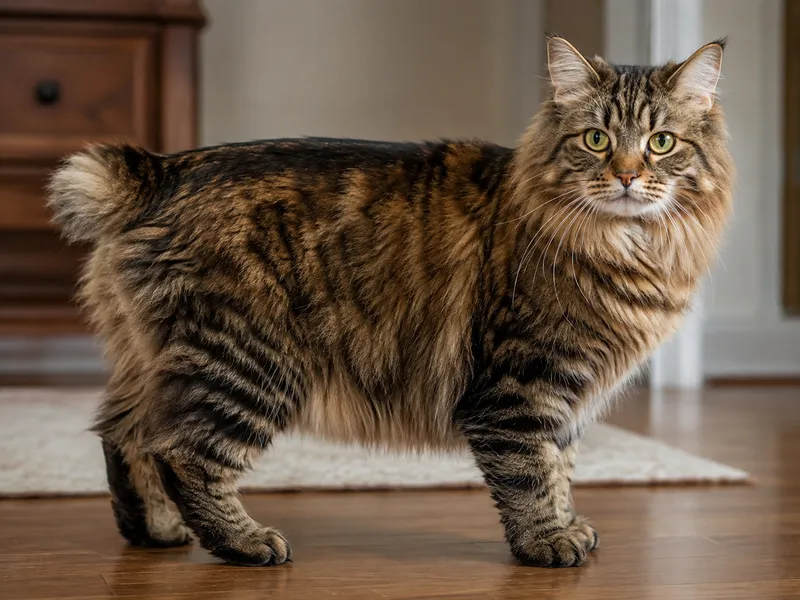
American Bobtail Longhair
The American Bobtail Longhair is the medium-longhaired form of the American Bobtail, a naturally short-tailed breed developed in North America. Modern breed development began in the late 1960s after a bobtailed cat…
Tanıyan kuruluşlar: CFA · TICA
Boyut
Büyük
Ağırlık
3.2–7.3 kg
Yaşam süresi
11–15 yıl
Irk Özellikleri
Enerji Seviyesi
Orta enerji
Enerji Seviyesi: 3 / 5
Düşük enerjiYüksek enerjiÇocuk / Aile Uyumu
Yüksek uyum
Çocuk / Aile Uyumu: 4 / 5
Düşük uyumYüksek uyumTüy Bakımı
Orta bakım ihtiyacı
Tüy Bakımı: 3 / 5
Az bakımYoğun bakımEğitilebilirlik
Kolay eğitilebilir
Eğitilebilirlik: 4 / 5
Zor eğitilirKolay eğitilirApartman / Ev Yaşamına Uygunluk
Apartmanda iyi uyum
Apartman / Ev Yaşamına Uygunluk: 4 / 5
Geniş alan / bahçe gerekirApartmana çok uygunYalnız Kalma Toleransı
Yarım gün zorlanır
Yalnız Kalma Toleransı: 2 / 5
Sürekli eşlik isterUzun yalnızlığa dayanırİlk Kez Sahiplenecekler İçin Uygunluk
Birçok ilk sahip için uygun
İlk Kez Sahiplenecekler İçin Uygunluk: 4 / 5
Deneyimli sahip gerekirİlk kez sahiplenmeye çok uygunDiğer Evcil Hayvanlarla Uyum
Genellikle diğer evcil hayvanlarla iyi anlaşır
Diğer Evcil Hayvanlarla Uyum: 4 / 5
Tek evcil hayvanlı ev daha uygunDiğer hayvanlarla çok uyumlu
The American Bobtail Longhair is the medium-longhaired form of the American Bobtail, a naturally short-tailed breed developed in North America. Modern breed development began in the late 1960s after a bobtailed cat known as Yodi produced short-tailed offspring. Later breeders broadened the foundation with unrelated naturally bobtailed domestic cats rather than creating the breed from wild feline ancestry.
This is a medium-to-large, substantial, athletic cat with a broad modified wedge-shaped head, prominent whisker pads, large expressive eyes, strong boning, and a muscular rectangular body. The natural bobtail must be clearly shorter than a normal tail and can be straight, curved, slightly kinked, or hooked, with considerable individual variation.
The Longhair has a resilient, slightly shaggy double coat of medium-long length. Hair becomes somewhat longer around the ruff, britches, belly, and tail, and toe tufts and facial furnishings may add to the rugged appearance. CFA treats Longhair and Shorthair as divisions of the American Bobtail, while TICA uses American Bobtail for the longhaired form and lists American Bobtail Shorthair separately.
American Bobtail Longhairs are generally affectionate, intelligent, confident, and adaptable. They commonly form bonds with the whole household rather than attaching exclusively to one person and tend to enjoy being involved in family activity without being relentlessly demanding.
Most are moderately active rather than extremely energetic. Interactive hunting games, retrieving, food puzzles, climbing, and reward-based training provide useful outlets, and many individuals can learn to walk on a harness or perform simple tricks.
Well-socialized American Bobtail Longhairs may live successfully with respectful children, compatible cats, and cat-friendly dogs. They generally value regular companionship and are not an ideal choice for a household where the cat will routinely spend very long periods alone.
The medium-long double coat is relatively resilient and is not intended to be cottony or excessively prone to matting. Thorough combing about twice a week is appropriate for many cats, with additional attention during seasonal shedding. Check the ruff, belly, armpits, britches, toe tufts, and shaggy tail furnishings for developing tangles.
The bobtail should never be pulled, twisted, or deliberately straightened. Routine grooming provides a useful opportunity to notice tenderness, swelling, wounds, reduced tail mobility, or changes in how the cat carries its tail. Any painful or sudden change should be assessed by a veterinarian.
Provide daily interactive play, sturdy climbing and scratching furniture, dental care, nail trimming, clean litter facilities, and measured portions of a complete life-stage-appropriate diet. Because the breed is heavily boned and muscular, healthy body condition should be judged by muscle and fat cover rather than assuming that every large number on the scale represents excess weight.
Published breed-specific clinical health data for the American Bobtail remain limited. Research has shown that some short-tailed American Bobtails carry frameshift variants in TBXT, the gene also involved in short-tail phenotypes in Manx and some Pixiebob cats. However, multiple American Bobtails with the characteristic short tail have tested negative for the known variants, indicating that the genetic basis of the breed's tail is heterogeneous rather than explained by one universal mutation.
The presence of a TBXT variant in an American Bobtail does not by itself establish that the cat will develop the neurologic, spinal, bowel, or bladder disorders historically associated with severe Manx phenotypes. Conversely, a negative result for currently known short-tail variants cannot prove that tail and spinal development are genetically normal. Large American Bobtail-specific studies defining the frequency of clinically important vertebral or neurologic complications are lacking.
Breeders should select for comfortable movement and functional tail structure and maintain family records covering spinal abnormalities, gait, urinary and fecal continence, reproductive history, neonatal losses, longevity, and causes of death. Prospective owners should seek veterinary assessment if a cat develops hind-limb weakness, an abnormal gait, tail pain, persistent constipation, urinary difficulties, or loss of bowel or bladder control, and should view any available TBXT result as one piece of information rather than complete health clearance. This information is for general educational purposes and is not a substitute for diagnosis or treatment by a veterinarian.
Tanıyan kuruluşlar
Bu ırkı listelerinde tutan bağımsız kayıt kuruluşları. Ayrıntı için rozete dokunun.
Bu statüler kuruluşların kayıt ve yarışma sistemlerindeki konumu gösterir; sağlık, kalite veya üstünlük puanı değildir.
Sık sorulan sorular
Are American Bobtail Longhairs good family cats?
American Bobtail Longhairs are generally affectionate, adaptable, and strongly interested in their household. They often suit families that can provide regular companionship, interactive play, and gentle handling.
Are American Bobtail Longhairs good with children?
Many well-socialized individuals live successfully with respectful children. Adults should supervise younger children, prevent pulling of the bobtail or coat, and make sure the cat always has the option to leave an interaction.
Do American Bobtail Longhairs get along with other pets?
They generally have good potential to live with compatible cats and cat-friendly dogs after gradual introductions. Separate food, water, litter, resting, and hiding resources help reduce competition and allow relationships to develop naturally.
Can an American Bobtail Longhair live in an apartment?
Yes. Their moderate activity level and adaptable temperament can suit apartment life when they receive daily play, sturdy climbing furniture, scratching surfaces, puzzle activities, and secure windows or balconies.
Can American Bobtail Longhairs be left alone during the day?
Many adults can manage ordinary periods alone, but the breed generally values companionship and is poorly suited to frequent prolonged isolation. A predictable routine and enrichment help, but they do not completely replace social contact.
How much grooming does an American Bobtail Longhair need?
Combing about twice a week is sufficient for many cats because the shaggy double coat is intended to be resilient rather than easily matted. More frequent grooming may be needed during seasonal shedding, especially around the ruff, belly, britches, and tail.
What is the difference between an American Bobtail Longhair and an American Bobtail Shorthair?
They share the same general body type, bobtail, temperament tendencies, and breed history. The Longhair has a medium-long shaggy double coat with longer furnishings, while the Shorthair has a shorter resilient double coat and usually requires less combing.
What health screening should an American Bobtail breeder provide?
Ask for veterinary records and family information covering mobility, spinal abnormalities, tail function, urinary and fecal continence, reproductive history, longevity, and causes of death. Known TBXT variants can be tested in some lines, but a negative DNA result does not exclude every genetic cause of the bobtail or guarantee overall health.
American Bobtail Longhair hakkında daha fazla
Pet profilleri yakında. Şimdilik güvenilir ırk bilgisine Irk Rehberi’nde devam edebilirsiniz.
Irk Rehberine Dön